

Top Bespoke Guitar Builders in UK: 2026 Directory
Table of Contents
- Best Bespoke Guitar Builders in the UK
- Bespoke vs. Production: Which Path Is Right for You?
- Cost of Custom Guitar UK: Pricing Guide by Builder
- How to Commission a Custom Guitar: Step-by-Step Process
- Luthier Guitar Build Time: What to Expect
- The Handcrafted Advantage: Guitar Building Process & Craftsmanship
- Post-Purchase Maintenance: Keeping Your Bespoke Guitar in Peak Condition
- Conclusion
Last Updated: July 9, 2026
When searching for bespoke guitar builders in uk, you're seeking a craftsperson who understands that every instrument is an extension of the player's voice. The UK has a thriving community of luthiers and boutique builders who create hand-built guitars tailored to exact specifications. Unlike mass-produced instruments, bespoke guitars are made-to-order, allowing players to choose everything from tonewoods and hardware to pickup configurations and finishes.
Best Bespoke Guitar Builders in the UK
1. Haynes Guitar & Bass Build, Hand-Built Craftsmanship for Superior Tone
Haynes Guitar & Bass Build stands at the top of the UK's bespoke guitar scene by combining decades of luthiery expertise with a relentless focus on tone. Every instrument is hand-built from raw materials with hand-wound pickups designed in-house to deliver exact sonic character.
Their range includes the Demeanour Custom Guitar (£3,200), the Fidelity Guitar (£3,200), and the SC22 Custom Guitar (£3,600), alongside bass options like the Custom Five String Jazz Bass (£2,100) and the Golden Root series starting at £1,800. The process is straightforward: discuss your vision, specify preferences across body style, neck profile, tonewoods, hardware, and pickup configuration, then receive your instrument fully set up and ready to play.

Their hand-wound pickups are a major differentiator, carefully crafted units voiced specifically for each guitar's body and neck combination. Haynes excels for players who want a personal build experience without months-long wait times.
2. PJD Guitars, Modern Engineering Meets Traditional Craftsmanship
PJD Guitars, based in York, bridges traditional hand-building and modern player-focused engineering. They manufacture most components in-house, giving complete control over quality and consistency.
Their approach includes brass inserts for bolt-on neck stability, quarter-sawn roasted maple necks that resist humidity changes, and partnerships with premium pickup brands like Bareknuckle. These practical solutions address playability and durability issues immediately. PJD's in-house manufacturing means faster turnaround than some competitors, though demand can create waiting lists.
3. LT Custom Guitars, Exotic Tonewoods and Interactive Design
LT Custom Guitars specializes in visually striking instruments built from exotic tonewoods and resin hybrids. Their online visualizer tool lets you design your guitar interactively before committing to a build, transforming the commissioning process from abstract discussion to concrete visualization.
This workflow saves time and miscommunication for players who know exactly what they want aesthetically. Each instrument is one-of-a-kind, built from hand-crafted construction.
4. Turnstone Guitar Company, Bespoke Acoustics for Fingerstyle Players
Turnstone specializes in high-end handcrafted acoustic guitars tailored for fingerstyle players. Their design philosophy prioritizes ergonomics, playability, and hand-voiced tone, with each guitar individually adjusted for optimal acoustic response before delivery.
One-on-one consultation throughout the build process covers body size, bracing patterns, wood selection, and finish. Turnstone builds to commission with substantial waiting lists.
5. Sam McClaren Guitars, Personal Attention and Versatility
Sam McClaren, based in North Yorkshire, builds both acoustic and electric guitars with focus on individual player comfort and specific tonal goals. His small-batch approach, typically working on two guitars simultaneously, ensures each commission receives dedicated attention.
He solves specific problems collaboratively and offers professional setups and repair services, making him a valuable long-term resource. His workshop maintains reasonable turnaround times compared to larger boutique builders.
6. Maybury Guitars, Vintage Aesthetics with Modern Playability
Maybury Guitars, based in Surrey, creates hand-built custom guitars and basses inspired by 50s and 60s designs. They capture authentic vintage aesthetics while incorporating modern hardware, electronics, and construction techniques that ensure reliability and playability.
Their custom options are built to commission, ideal for players who want instruments that look vintage but perform like contemporary builds.
7. Swannell Guitars, Master Craftsmanship and Unique Instruments
Swannell, based in Cambridge, creates handcrafted acoustic and electric guitars blending traditional techniques with modern design. Each instrument is unique with no model lineup, just custom builds tailored to individual players. This guarantees an instrument unlike anything else, though with longer wait times.
8. Yarde Guitars, Innovative Electric Designs from Raw Materials
Yarde Guitars, based in Cornwall, specializes in custom electric guitars built from raw materials, including innovative headless models. Their approach focuses on ergonomic design and player-centric innovation. Headless guitars offer advantages for travel, reduced neck stress, and unique aesthetics.
Bespoke vs. Production: Which Path Is Right for You?
A bespoke guitar is made-to-order specifically for you, with complete control over body wood, neck profile, hardware, pickups, finish, and inlays. The luthier builds from raw materials, hand-finishing and setting up before delivery. This typically takes 8-16 weeks.
Production guitars are built in batches to standardized specifications, allowing faster delivery (4-8 weeks) and lower prices. The real trade-off isn't quality, boutique builders maintain high standards either way, it's customization versus speed and cost.
| Aspect | Bespoke Build | Production Model |
|---|---|---|
| Timeline | 8-16 weeks | 4-8 weeks |
| Customization | Complete control over specs | Limited to model options |
| Price Range | £1,800-£3,600+ | £1,500-£2,800 |
| Ideal For | Players with specific visions | Players happy with existing designs |
| Setup & Adjustment | Hand-voiced by builder | Factory standard setup |
| Uniqueness | One-of-a-kind | Standardized model |
Choose bespoke if you have specific tonal goals, ergonomic needs, or aesthetic preferences that production models don't address. Haynes Guitar & Bass Build offers both approaches, their made-to-order instruments like the Demeanour and SC22 are fully customizable, while their Golden Root series provides standardized designs with faster availability.
Cost of Custom Guitar UK: Pricing Guide by Builder
Entry-level bespoke guitars start around £1,800-£2,100. Haynes's Golden Root series (ST, TT, P Bass, J Bass) sits at £1,800, offering hand-built construction with hand-wound pickups and customizable finishes.
Mid-range bespoke guitars run £2,500-£3,500. Haynes's Demeanour (£3,200) and Fidelity (£3,200) offer extensive customization and premium tonewoods. The SC22 (£3,600) represents the upper end with premium hardware and complex inlay work.
High-end bespoke guitars exceed £4,000, potentially reaching £6,000+ depending on materials and complexity.
Several factors influence pricing:
Tonewoods. Standard options like alder and maple cost less than figured maple or exotic woods like cocobolo. Expect 15-30% more for premium combinations.
Hardware. Standard hardware is included in base pricing. Upgraded options add £200-£400.
Pickups. Hand-wound pickups are included in Haynes pricing. Boutique pickup brands add £300-£500.
Finish complexity. Solid color nitro finishes are standard. Relic finishes or complex color work add £200-£600.
Inlay and decoration. Custom inlays add £300-£800.
Waiting time premium. Expedited builds cost 10-20% more than standard pricing.
How to Commission a Custom Guitar: Step-by-Step Process
Step 1: Research and Contact Identify builders whose aesthetic appeals to you. Visit websites, examine finished instruments, and listen to audio samples. Contact 2-3 builders to discuss your vision.
Step 2: Initial Consultation Schedule a phone or video meeting. Discuss playing style, tonal preferences, ergonomic needs, and budget. Bring references and photos of guitars you love.
Step 3: Design Specification Finalize your design: body style, body wood, neck wood, fretboard wood, hardware, pickup configuration, electronics, finish, and decorative elements. Builders like LT Custom use visualizer tools. Most require a 30-50% deposit before beginning work.
Step 4: Build Phase Your guitar is constructed over 8-12 weeks. Some builders provide progress updates; others maintain radio silence until completion.
Step 5: Setup and Testing The builder performs final setup: fret leveling, nut and bridge adjustment, action optimization, and electronics testing.
Step 6: Final Payment and Delivery Pay the remaining balance. The builder ships your guitar (usually insured and tracked) or arranges local pickup.
Step 7: Receipt and Inspection Your guitar arrives. Inspect carefully and verify all specifications match your order. Most builders provide a 1-2 year warranty.
Luthier Guitar Build Time: What to Expect
Most UK bespoke builders quote 8-16 weeks for a standard custom build. Several factors extend this timeline:
Builder queue. Popular builders have waiting lists. You might wait 4-6 weeks before construction begins.
Design complexity. Complex offset designs with custom inlays take 2-4 weeks longer than straightforward Stratocaster-style guitars.
Material sourcing. Exotic woods may require ordering, adding time.
Finishing work. Nitro finishes cure slowly. Relic finishes require additional hand-work, extending finishing by 2-4 weeks.
Seasonal demand. Summer and December see increased orders and longer queues.
Expedited builds. Some builders offer expedited service for 10-20% premium, reducing wait time by 4-8 weeks.
The Handcrafted Advantage: Guitar Building Process & Craftsmanship
Wood Selection and Preparation
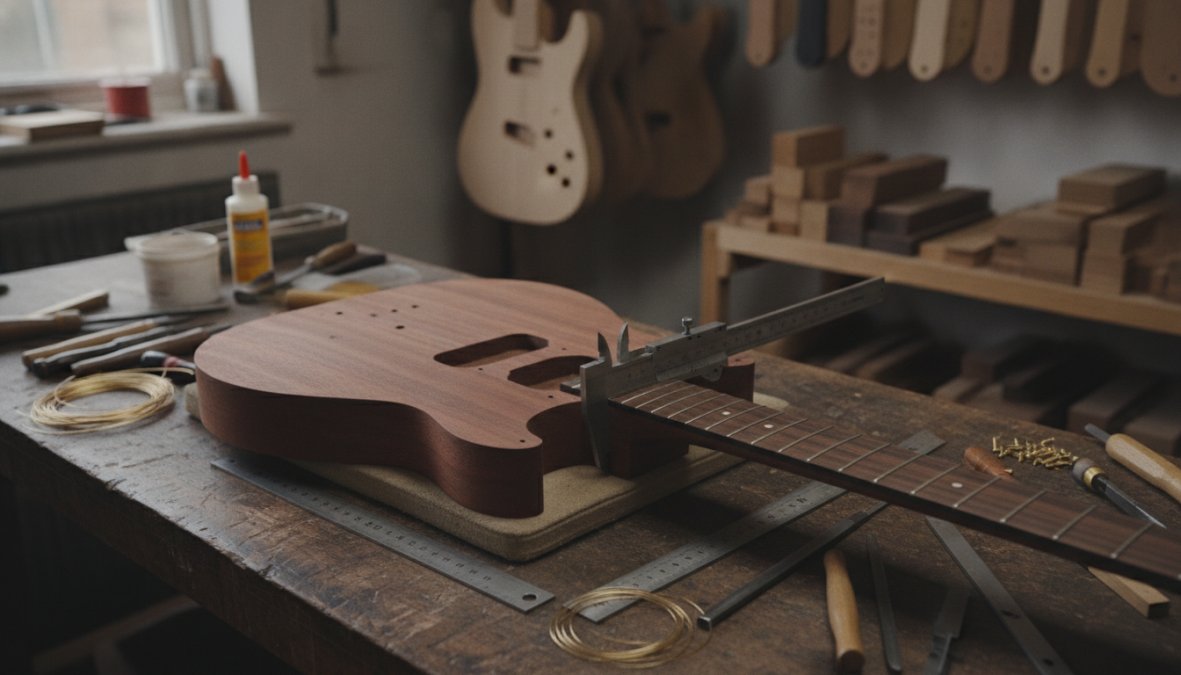
Bespoke builders source tonewoods personally, selecting based on grain structure, density, and acoustic properties. They work with raw lumber, choosing boards for specific characteristics that influence tone and appearance. Wood is dried, planed, and acclimated to ensure stability and prevent fret sprout, neck twist, and finish checking.
Body and Neck Construction
The luthier shapes body and neck by hand using hand planes, chisels, and sanders alongside modern tools. Joints are fit carefully, often with hand-cut dovetails or mortise-and-tenon joints providing superior strength compared to bolted joints.
Fretwork and Finishing
Frets are installed with precision, then leveled, crowned, and polished by hand. This meticulous work separates playable instruments from frustrating ones. Hand-applied finishes allow the builder to adjust thickness, color, and texture based on wood characteristics. Nitro finishes cure slowly, allowing hand-rubbing and subtle adjustments.
Electronics and Hardware Installation
Hand-wound pickups are wound individually, allowing adjustment based on the specific guitar's construction. Hardware is installed with attention to alignment and functionality. Electronics are wired and tested thoroughly.
Setup and Final Inspection
The luthier plays the instrument extensively, making micro-adjustments and verifying everything functions as intended. This hands-on testing catches issues factory quality control might miss.
The cumulative effect is an instrument that plays better, sounds better, and lasts longer. Hand-built guitars respond with nuance and sensitivity, developing character over time rather than degrading.
Post-Purchase Maintenance: Keeping Your Bespoke Guitar in Peak Condition
Regular Playing and Humidity Control
Play your guitar regularly. Maintain consistent humidity (40-50%) in your playing space. Store your guitar in its case when not playing for environmental protection.
String Maintenance
Change strings every 3-6 months depending on playing frequency. Wipe strings after playing to remove oils and sweat, extending string life.
Fretboard Care
Clean your fretboard every 3-6 months using a soft cloth and lemon oil (for rosewood and ebony) or specialized fretboard conditioner. Avoid silicone-based products.
Hardware and Electronics
Inspect tuning machines, bridge, and hardware periodically. Tighten loose screws and check that tuning machines turn smoothly. Test electronics regularly and have a luthier inspect any scratchy or intermittent issues.
Finish Maintenance
Nitro finishes develop patina over time. Use a soft cloth and mild soap and water for cleaning. Avoid harsh cleaners, extreme heat, and direct sunlight.
Annual Professional Setup
Your guitar benefits from annual professional setup. A luthier checks fret height, intonation, action, and structural integrity, identifying potential issues before they become problems.
Proper maintenance transforms a bespoke guitar into a lifetime instrument. With care, your hand-built guitar will improve with age, developing character and resonance that mass-produced instruments cannot match.
Research from The Craftsmanship Council UK indicates that hand-built instruments appreciate in value over time, particularly when maintained properly by their original owners.
Understanding the landscape of bespoke guitar builders in uk helps you make an informed decision. Whether you choose Haynes Guitar & Bass Build for their hand-wound pickups and made-to-order approach or explore other boutique builders, the key is finding a craftsperson whose philosophy aligns with your playing style and sonic vision.
The commissioning process requires patience, but the result is an instrument tailored specifically to you. A hand-built guitar responds to your touch, amplifies your musical voice, and becomes an extension of your artistic expression in ways production models cannot match.
If you're ready to explore custom options, start by contacting builders whose work resonates with you. Share your vision, discuss your budget and timeline, and ask detailed questions about their process. A good luthier welcomes this conversation.
For players seeking hand-built quality, customization, and superior tone, UK Luthier Directory provides a comprehensive resource for connecting with builders across the country. Haynes Guitar & Bass Build represents the pinnacle of what UK bespoke guitar building can achieve, delivering hand-built tools designed specifically for superior tone and playability.
Start your journey toward a bespoke guitar today. The instrument you commission will become your most trusted musical companion.
Frequently Asked Questions
How much does a bespoke guitar cost in the UK?
Bespoke guitar pricing in the UK varies widely depending on the builder, specifications, and materials. Entry-level handcrafted electric guitars typically start around £1,800-£2,100, while premium custom builds can exceed £3,600. Haynes Guitar & Bass Build offers custom guitars from £1,800 (Golden Root models) to £3,600 (SC22), with basses ranging from £1,800-£2,100. Acoustic bespoke guitars often command higher prices due to their tonal complexity and hand-voicing requirements.
How long does it take to build a custom guitar?
Luthier guitar build time typically ranges from 3-12 months, depending on the builder's workload, design complexity, and material sourcing. Most UK bespoke builders work on a commission-only basis with waiting lists. Smaller luthiers like Sam McClaren Guitars build two guitars at a time, which naturally extends timelines. Builders with higher demand, such as Turnstone Guitar Company, may have waiting lists of several months. When commissioning a custom guitar, always confirm expected delivery during your initial consultation.
What is the difference between a bespoke guitar and a production model?
A bespoke guitar is handcrafted to your exact specifications by a luthier, allowing complete customization of body shape, tonewoods, pickups, hardware, and finish. Production models, even high-end ones, are built to predetermined specs. Bespoke guitars offer superior personalization and often superior tone due to hand-selected materials and meticulous craftsmanship. However, they require longer build times and higher investment. Production guitars offer faster delivery and lower costs but limited customization. Choose bespoke if tone, uniqueness, and personal fit are priorities; choose production for immediate availability.
How do I find a reputable luthier in the UK?
Research builders online through their websites and portfolios, look for detailed images of completed instruments and clear communication about their process. Read reviews from past clients and ask for references. Check their workshop credentials and whether they offer repairs or setups, which indicates broader expertise. Visit in person if possible to assess craftsmanship firsthand. Reputable builders are transparent about pricing, build times, and design process. Join guitar forums and communities to get peer recommendations. Established builders like Haynes Guitar & Bass Build, PJD Guitars, and Maybury Guitars have strong reputations and detailed online portfolios.
Are custom-made guitars worth the investment?
Custom-made guitars are worth the investment if you prioritize tone, playability, and a instrument tailored to your exact needs. Handcrafted guitars built by skilled luthiers often produce superior sound due to premium tonewoods, hand-wound pickups, and meticulous setup. They retain value better than mass-produced instruments and become heirlooms. However, they require patience (longer build times) and higher upfront cost. If you're a serious player seeking a long-term instrument or have specific tonal/ergonomic requirements, bespoke is worthwhile. Casual players or those on tight budgets may find production guitars more practical.
This article was written using GrandRanker