

Bespoke vs Mass Produced Guitars: Key Differences Explained
Table of Contents
- Bespoke vs Mass Produced Guitars: Understanding the Core Differences
- Craftsmanship and Manufacturing: Hand-Built vs Factory Production
- Custom Shop Guitar vs Production Model: Customization and Specifications
- Material Selection, Tonewood Quality, and Tonal Profile
- Guitar Resale Value Comparison: Investment Potential and Long-Term Worth
- Cost Analysis: Price, Maintenance, and Repairability
- The Mid-Tier Hybrid Model: Bridging Bespoke and Mass Production
- Consistency, Quality Control, and Playability Standards
Bespoke vs Mass Produced Guitars: Key Differences Explained
Last Updated: July 10, 2026
When shopping for a guitar, the choice between a hand-built instrument and a factory-produced model shapes your sound and relationship with the instrument. Understanding the real differences helps you make a choice aligned with your playing style, budget, and goals.
The gap extends beyond craftsmanship philosophy to consistency, tonal character, customization, resale value, and manufacturing economics. Most players assume handmade is always better, but the reality is nuanced. Some mass-produced guitars deliver exceptional value and reliability. Some bespoke builds fall short.
What Defines Bespoke Guitars
A bespoke guitar is a fully custom instrument built to your exact specifications by a skilled luthier or small workshop. Unlike production models, bespoke guitars begin with a conversation about your playing style, tonal preferences, body shape, wood selections, hardware, and finish options.
Bespoke builds typically take months to complete. A luthier sources specific tonewood based on your sonic goals, hand-selects hardware, and voices the instrument for your technique. Every decision is deliberate, the wood selection is chosen for how it will sound in your hands, the neck profile is tailored to your hand size, and the finish is hand-rubbed to your preference. Bespoke guitars typically start around £1,800 and climb significantly higher depending on specifications and materials.
What Defines Mass-Produced Guitars
A mass-produced guitar is manufactured in a factory using standardized processes, CNC machinery, and assembly-line efficiency. These instruments are designed once, then replicated hundreds or thousands of times. The Fender American Professional II Stratocaster follows the same specifications whether it's the first unit or the ten-thousandth.
Mass production prioritizes consistency and cost efficiency. Every neck is shaped identically, every body receives the same finish process, and hardware meets exact tolerances. Quality control happens at checkpoints along the assembly line. The economics create lower prices and wider availability, democratizing access to quality instruments for players who can't afford bespoke customization.
Craftsmanship and Manufacturing: Hand-Built vs Factory Production
The distinction reflects fundamentally different philosophies about how instruments should be made.
The Role of the Luthier in Bespoke Builds
A luthier is a skilled craftsperson who designs and builds guitars by hand, often with minimal power tools and maximum attention to detail. The luthier's process is iterative and responsive. As they work, they listen to how the wood responds, adjust bracing patterns based on vibration, and voice the instrument repeatedly to ensure it develops the tonal characteristics you want. This responsiveness requires skill accumulated over years and intuition developed through thousands of hours at the workbench.
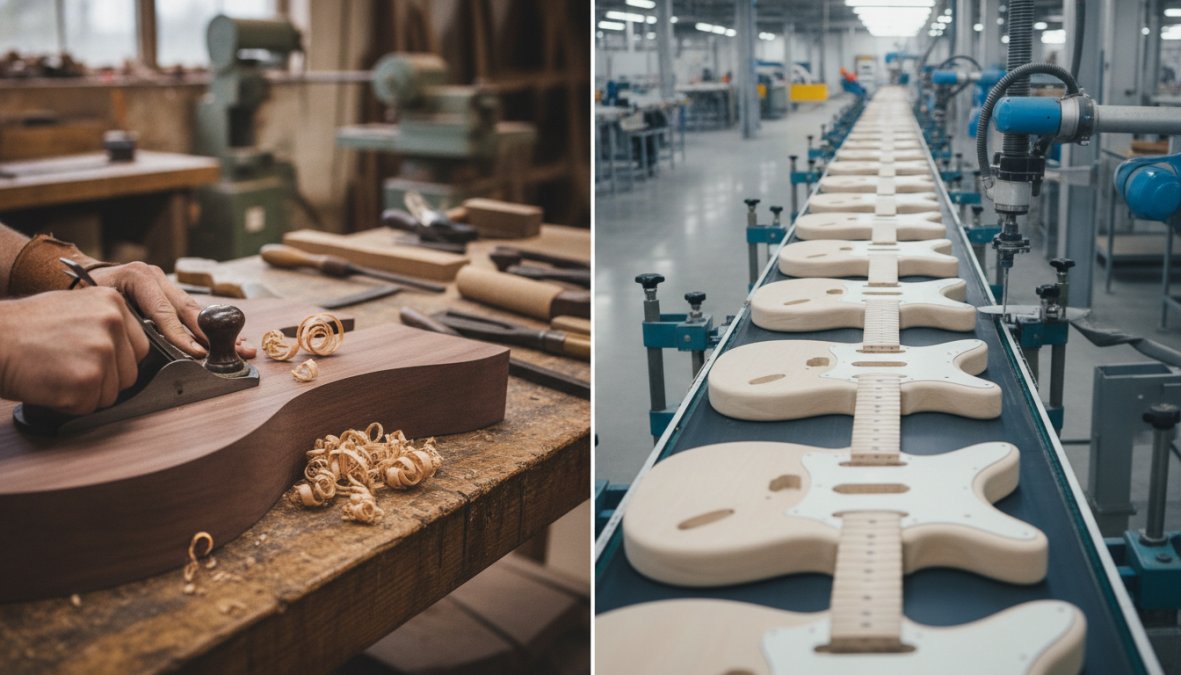
CNC Machining and Standardization in Mass Production
CNC (Computer Numerical Control) machining revolutionized guitar manufacturing by carving bodies and necks with precision tolerances measured in fractions of a millimeter. A CNC machine shapes a guitar body in 45 minutes; a luthier might spend 20 hours on the same task. This efficiency scales across thousands of units per year, making guitars affordable at every budget level.
CNC machining introduced standardization to parts that previously varied: neck profiles, body dimensions, fret spacing, and hardware mounting points. This standardization created an ecosystem of compatible parts and enabled any competent technician to understand the architecture immediately. The trade-off is flexibility, a CNC machine produces what it's programmed to produce, and customization requires reprogramming, a significant cost that only makes sense for high-volume runs.
Custom Shop Guitar vs Production Model: Customization and Specifications
The difference between a custom shop guitar and a production model shapes your playing experience concretely.
Bespoke Customization Options
When you commission a bespoke build, customization is nearly unlimited. You control body wood and finish, neck profile and dimensions, hardware and electronics, aesthetic details, and tonal voicing. The Haynes Demeanour Custom Guitar, starting at £3,200, exemplifies this approach, fully customizable to your specifications, built with hand-wound pickups and crafted specifically for superior tone.
Limited Customization in Mass-Market Models
Production models offer customization within defined parameters. A Fender Stratocaster comes in multiple body colors, but the body shape is fixed. You can choose between different pickup configurations, but only the ones Fender offers. This limitation reflects manufacturing reality: a factory can't efficiently produce one-off variations.
| Customization Aspect | Bespoke Build | Mass-Produced Model |
|---|---|---|
| Body Wood Selection | Unlimited tonewood options | 3-5 standard woods |
| Neck Profile | Custom dimensions | 1-2 standard profiles |
| Finish Options | Custom colors and aging | 6-12 preset finishes |
| Hardware | Any configuration possible | Preset electronics packages |
| Build Timeline | 4-8 months typical | Immediate availability |
| Price Range | £1,800-£7,000+ | £500-£3,500 typical |
Material Selection, Tonewood Quality, and Tonal Profile
The wood you choose shapes your guitar's sound more than any other factor.
Hand-Selected Tonewood in Bespoke Instruments
When a luthier builds a bespoke guitar, they hand-select wood specifically for your instrument. They examine multiple pieces of spruce or rosewood, listen to how each resonates, and consider grain structure, density, and age. A skilled luthier can assess wood and predict how it will sound in a finished instrument, selecting the piece that will deliver the tonal character you want.
Consistency vs Character in Mass Production
Mass-produced guitars prioritize consistency in materials and construction. Manufacturers source tonewood in bulk from suppliers meeting specifications for density, moisture content, and dimensions. This consistency is genuinely valuable, a player buying a Martin D-28 knows what they're getting. However, consistency comes at the cost of tonal variation, as instruments are voiced for a target tonal profile rather than individual player preferences.
Wood selection accounts for approximately 40-50% of an instrument's tonal character, with remaining factors split between construction technique, hardware, and player technique.
Guitar Resale Value Comparison: Investment Potential and Long-Term Worth
How much your guitar is worth five years from now depends significantly on whether it's bespoke or mass-produced.
Bespoke Guitars as Collectible Investments
Bespoke guitars often appreciate in value over time, particularly instruments built by respected luthiers. A custom guitar becomes more valuable as the luthier's reputation grows and fewer instruments from that period exist. Appreciation happens because of scarcity, maker reputation, sonic character, and personal history. However, bespoke appreciation is unpredictable, not every custom build appreciates; the luthier's reputation matters enormously.
Mass-Produced Guitar Resale Markets
Mass-produced guitars depreciate more predictably. A new Fender Stratocaster loses 20-30% of its value in the first year, then stabilizes at roughly 40-60% of its original price in five years. The advantage is market liquidity, you can sell a Fender quickly because there's an active market.
Cost Analysis: Price, Maintenance, and Repairability
The total cost of ownership extends beyond the initial purchase price.
Initial Investment and Cost of Goods Sold
A bespoke guitar costs more upfront. The Haynes SC22 Custom Guitar at £3,600 represents a significant investment compared to a Gibson Les Paul Standard at £2,000-£2,500. Bespoke builds require skilled labor spread across months of work, while mass production amortizes labor costs across hundreds or thousands of units. However, cost-per-hour of use tells a different story, a player who buys a bespoke guitar and plays it regularly for 20 years gets exceptional value.
Long-Term Maintenance and Repair Accessibility
Mass-produced guitars have a significant advantage in maintenance and repair accessibility. Any competent guitar technician can service a Fender or Gibson, and parts are widely available. Bespoke guitars present different challenges, if your custom instrument needs repair, you ideally return to the original maker. However, well-built bespoke instruments often require less maintenance overall.
The Mid-Tier Hybrid Model: Bridging Bespoke and Mass Production
The most interesting development is the emergence of hybrid models combining mass-production efficiency with bespoke customization. PRS Private Stock offers extensive customization while manufacturing in a factory, typically costing £7,000 and up. Collings Custom Guitars uses CNC machining for consistent body and neck production, then hand-finishes and hand-voices each instrument individually, with prices ranging from £6,000-£9,000.
The hybrid approach addresses real limitations of pure bespoke and pure mass production, offering more customization than a standard production model without waiting months or paying premium bespoke prices.
| Manufacturing Approach | Customization Level | Build Timeline | Price Range | Best For |
|---|---|---|---|---|
| Mass Production | Limited (preset options) | Immediate | £500-£2,500 | Budget-conscious, immediate availability needs |
| Hybrid/Custom Shop | Moderate (selected options) | 2-4 months | £3,000-£6,000 | Players wanting customization without long wait |
| Bespoke/Handmade | Unlimited | 4-8 months | £1,800-£7,000+ | Players with specific sonic/aesthetic vision |
Consistency, Quality Control, and Playability Standards
Mass production excels at consistency, every unit from a production run should play and sound remarkably similar. However, "consistent" doesn't mean "perfect." Consistency is a feature of the manufacturing process, but the quality level varies by manufacturer.
Bespoke guitars vary more widely, but the ceiling is higher. A well-built custom instrument will outplay most mass-produced guitars. The playability difference becomes apparent when you pick up the instruments, a bespoke guitar feels intentional, with a neck profile matching your hand and action set exactly as you prefer. Modern mass-production techniques have closed the quality gap significantly, making the distinction today less about quality and more about customization and character.
The choice between bespoke vs mass produced guitars ultimately reflects your priorities. If you know exactly what you want, have specific tonal goals, and play regularly enough to justify the investment, a bespoke build delivers unmatched personalization. If you want a reliable instrument immediately, need easy access to parts and repairs, or are exploring your playing style, a mass-produced guitar offers better practical value.
Both approaches can deliver excellent instruments. A well-made mass-produced guitar will serve you beautifully for decades. A bespoke guitar built by a skilled luthier becomes an extension of your playing.
At Haynes Guitar & Bass Build, we specialize in bespoke instruments like the Haynes Demeanour Custom Guitar and Haynes SC22 Custom Guitar, built with hand-wound pickups and crafted specifically for superior tone. If you're ready to commission an instrument designed exactly for your playing style and sonic preferences, we're here to bring your vision to life.
Frequently Asked Questions
Are bespoke guitars actually better than mass produced ones?
Not universally, it depends on your priorities. Bespoke guitars often excel in tonal character, customization, and craftsmanship tailored to your playing style. Mass-produced guitars offer consistency, affordability, and reliability. A high-quality mass-produced guitar like the Fender American Professional II may outperform a poorly executed bespoke build. The key difference lies in personalization rather than inherent superiority.
What's the price difference between custom shop guitars and production models?
Custom shop guitars typically range from £1,800 to £3,600+ for boutique UK builders like Haynes Guitar & Bass Build, with some reaching £7,000+ for premium bespoke instruments. Mass-produced guitars range from £500 to £3,500, depending on brand and quality. The premium for bespoke builds reflects hand-voicing, material selection, and labor-intensive craftsmanship rather than pure material costs.
Do bespoke guitars hold their resale value better than mass-produced ones?
Yes, generally. Bespoke guitars from established luthiers often appreciate or maintain value due to exclusivity, craftsmanship reputation, and collectibility. Mass-produced guitars depreciate faster but retain value in established markets (Fender, Gibson). Resale value depends on builder reputation, condition, and demand, a boutique instrument from a renowned luthier typically outperforms a mid-range factory guitar over time.
How long does it take to get a bespoke guitar compared to buying mass-produced?
Mass-produced guitars are available immediately or within weeks. Bespoke builds typically require 6-12 weeks or longer, depending on the luthier's workload and customization complexity. This wait time reflects the hand-crafted process, material sourcing, and meticulous setup required. Haynes Guitar & Bass Build offers made-to-order instruments with build times you can discuss directly with their team.
What maintenance differences exist between bespoke and mass-produced guitars?
Bespoke guitars often require specialized maintenance from the original luthier, as they're hand-voiced and may have unique hardware or construction methods. Mass-produced guitars benefit from standardized parts, wider technician availability, and easier repairs. However, quality bespoke instruments are typically more durable and require less frequent intervention due to superior wood selection and craftsmanship, offsetting accessibility challenges.
This article was written using GrandRanker