

Custom Guitar Body Routing Service: A Complete 2026 Guide
Table of Contents
- What Is Custom Guitar Body Routing Service?
- Understanding CNC Guitar Body Routing Technology
- Guitar Body Templates and Jigs: Building Your Specifications
- Pickup Cavity Routing and Electronics Installation
- Professional Luthier Services vs. DIY Routing
- How to Order Your Custom Routed Guitar Body
- Wood Selection and Body Blank Preparation
- Common Mistakes to Avoid When Routing Custom Bodies
Custom Guitar Body Routing Service: A Complete 2026 Guide
Last Updated: July 17, 2026
A custom guitar body routing service transforms raw wood blanks into precision instruments tailored to your exact specifications. Professional routing handles the technical complexity that separates a playable guitar from a non-functional one. The difference between DIY routing and professional CNC work isn't just aesthetics, it's tolerances. A pickup cavity routed 2mm too deep or a neck pocket 0.5mm out of square causes problems no finishing can hide.
What Is Custom Guitar Body Routing Service?
Custom guitar body routing service refers to precision machining of cavities, pockets, and channels in wooden guitar bodies using CNC (computer numerical control) equipment or hand-routing techniques. These services cut pickup cavities, control cavities, neck pockets, bridge routes, and tremolo channels that transform a blank piece of wood into a functional guitar body.
The service typically includes pickup cavity routing for single-coil, humbucker, or offset configurations; control cavity routing for potentiometers, switches, and wiring access; neck pocket machining with precise depth and angle specifications; bridge routing for vintage Fender specs, modern hardtails, or specialty tremolo systems; electronics access routes; and comfort contours like belly cuts or arm bevels.
What makes a service "custom" is the ability to deviate from standard templates. You provide CAD files or detailed specifications, and the shop machines exactly what you need.
Understanding CNC Guitar Body Routing Technology
CNC routing machines use rotating bits guided by computer programs to cut precise channels and cavities into wood. Unlike hand routing, which relies on skill to maintain consistent depth and straight edges, CNC machines follow digital instructions with tolerances measured in fractions of a millimeter.
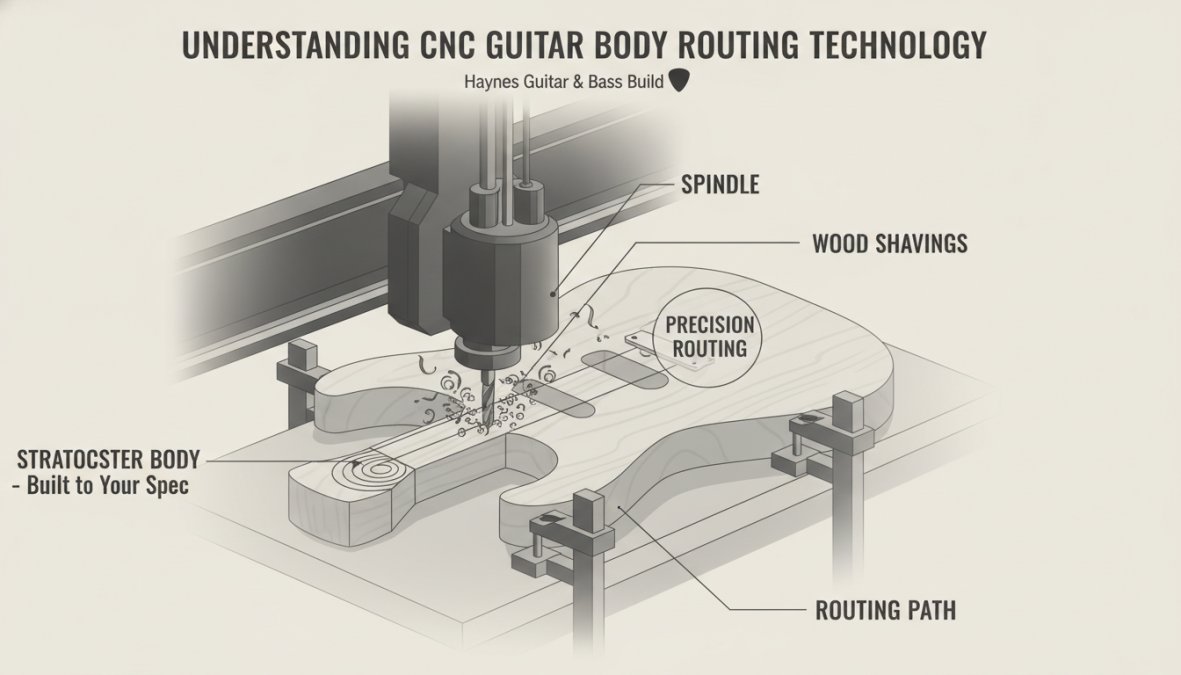
The process begins with your CAD file (typically DXF format) containing 2D or 3D coordinates for every route. The operator loads the file into control software, verifies measurements, secures the body blank in a vacuum-hold fixture, and initiates the program. The machine then follows the path automatically, moving the cutting bit in X, Y, and Z axes to achieve exact depth, width, and shape.
CNC routing offers repeatability, speed (1-3 hours versus 8-12 hours for hand routing), precision tolerances of ±0.5mm (versus ±2-3mm for hand routing), complex geometry capabilities, and superior finish quality. The trade-off is cost, CNC equipment requires significant investment, while hand routing is cheaper per unit but slower and less precise.
Precision Standards and Tolerance Requirements
Professional routing services typically work to tolerances of ±0.5mm to ±1mm for cavity depth and width. Neck pocket tolerances are even tighter at ±0.25mm, since a neck pocket that's too shallow creates a gap between body and neck; too deep and the neck sits recessed.
Bridge routing tolerances depend on the bridge type. A hardtail bridge with threaded inserts needs holes within ±0.5mm to prevent thread stripping. A vintage Fender-style bridge plate route must be flat and level within ±1mm, or the bridge will rock and cause tuning instability.
When ordering routing services, ask the shop what tolerances they hold and whether they test-fit components before shipping.
Guitar Body Templates and Jigs: Building Your Specifications
A guitar body template is a 1:1 scale outline defining the perimeter, pickup positions, control cavity location, and all other features. Modern templates are digital files, but they serve the same purpose as traditional plywood guides.
Creating accurate templates requires the body outline (perimeter shape), pickup positions (distances from the neck pocket to each pickup cavity center), control cavity location (X/Y coordinates), bridge routing area (footprint of your bridge system), neck pocket dimensions (width, depth, angle, and position), and electronics access routes.
Precision here is non-negotiable. A pickup position that's 5mm off changes the guitar's tone and playability. A neck pocket 2mm too shallow prevents proper neck seating.
Creating CAD Designs and DXF File Formats
CAD files are digital blueprints that CNC machines read directly. The most common format is DXF (Drawing Exchange Format), a 2D vector format defining paths, dimensions, and coordinates. Some shops accept 3D formats like STEP or IGES for cavity depth and contours.
When creating your DXF file, set the scale to full size (1:1), specify units consistently (millimeters or inches), use a single line weight (0.1mm standard), organize into labeled layers (outline, pickups, cavities, bridges), and include reference dimensions for critical features.
Send your DXF file to the routing shop 2-3 weeks before you need the body. A reputable shop will review the file and contact you for clarification. If they don't, that's a red flag. File errors are the leading cause of routing failures.
Pickup Cavity Routing and Electronics Installation
The pickup cavity is the most critical routing on a guitar body. Any deviation from spec affects tone, sustain, and playability. Standard pickup cavities are routed to specific depths: single-coil pickups (32-35mm), humbucker pickups (40-43mm), and offset single-coils (34-37mm).
Always measure your actual pickups before specifying cavity dimensions. The cavity floor should be smooth and flat with clean walls requiring no additional finishing.
Control Cavity Configuration and Bridge Placement
The control cavity houses your potentiometers, switches, and wiring. A typical control cavity includes three 10-12mm holes for potentiometers, a 6-8mm hole for a toggle switch, small channels connecting pot holes, and a cavity depth of 30-40mm.
Before routing, create a detailed electronics layout showing exact X/Y position of each pot hole, hole diameter, wire channels, and cavity depth.
Bridge placement determines intonation and sustain. For a hardtail bridge, you need threaded inserts routed into the body. For a vintage Fender-style bridge, you need a flat route that's perfectly level to prevent rocking.
Professional Luthier Services vs. DIY Routing
The choice between professional routing and DIY depends on your skill level, available tools, budget, and how many bodies you plan to build.
Professional routing services offer precision, speed, and reliability. A typical professional routing job costs $150-$400 depending on complexity. The body arrives ready for assembly with all cavities routed to spec. The downside is cost and lead time, most shops have 4-8 week turnarounds.
DIY routing requires hand tools (chisels, routers, bits, clamps, templates) and significant skill. A basic router costs $100-$300; a precision router table runs $500-$2,000. The learning curve is steep; most builders waste their first 2-3 bodies before achieving consistent results.
Many builders use a hybrid approach: order professionally routed bodies for pickups and neck pockets, then hand-route custom control cavities or contours themselves.
Cost-Benefit Analysis: When to Use Professional Services
Professional routing makes financial sense when you're building multiple guitars (economy of scale reduces per-body cost), your design is complex (custom shapes and contoured cavities are difficult to hand-route), precision matters (routing tolerances affect playability and durability), or time is valuable (DIY routing takes 8-12 hours per body).
DIY routing makes sense when you're building one guitar, want full control over custom contours, have a tight budget, or enjoy the craft.
Professional routing shops typically charge based on complexity: simple single-pickup bodies start at $150, multi-pickup or contoured bodies run $250-$400, and highly custom work can exceed $500.
How to Order Your Custom Routed Guitar Body
Ordering a professionally routed guitar body takes 6-10 weeks from order to delivery.
Step 1: Finalize your design (2-4 weeks) Before contacting a routing shop, lock in your body shape, pickup configuration, electronics layout, and bridge type. Any changes after ordering delay the job and might incur revision fees.
Step 2: Create your CAD file or provide specifications (1-2 weeks) If you have CAD skills, create a DXF file. If not, most shops accept detailed written specifications with measurements and sketches. Include body shape, pickup positions, pickup type, control cavity location and pot configuration, bridge type and position, neck pocket dimensions, and any custom contours.
Step 3: Contact the routing shop (1 week) Send your CAD file or specifications to 2-3 shops and request a quote. Ask about lead time, tolerances, test-fitting, and shipping options.
Step 4: Review the quote and confirm (1 week) Most shops will review your file and contact you with questions. Don't rush this step; a 5-minute phone call prevents a $300 mistake later. Confirm total cost, lead time, and whether the shop includes test-fitting or shipping.
Step 5: Submit payment and CAD file (immediate) Most shops require 50% deposit to start routing. Send your final CAD file, reference photos, and special instructions. Request a confirmation email with the expected delivery date.
Step 6: Wait for routing (4-8 weeks) The shop will route your body and conduct quality checks. Most reputable shops test-fit pickups and bridges before shipping. You'll receive a tracking number when the body ships.
Step 7: Inspect upon arrival (immediate) When your body arrives, inspect it immediately. Check all cavity dimensions with calipers, test-fit your neck, pickups, and bridge, and look for tool marks, splinters, or rough edges. Contact the shop within 24 hours if anything is wrong.
File Format Requirements and Design Submission
The most common file format is DXF (Drawing Exchange Format). Other acceptable formats include STEP or IGES (3D formats) and high-quality PDFs with dimensions.
When submitting your file, confirm that your file is 1:1 (full size), specify units consistently, include reference dimensions from a fixed point to each cavity, label each layer clearly, and note any specific tolerance requirements.
Most shops will review your file and request clarifications if anything is ambiguous. This review process typically takes 3-5 business days.
Shipping, Lead Times, and Quality Assurance
Lead times for custom routing typically range from 4-8 weeks. Rush orders (2-3 weeks) are possible but cost 25-50% more. Plan ahead.
Shipping costs depend on body size and destination. A guitar body weighs 1.5-2.5 kg and ships via UPS or FedEx Ground for $20-$50 domestically. International shipping runs $50-$150.
The best shops test-fit pickups and bridges before shipping, inspect cavity dimensions with calipers, check for splinters or rough edges, provide photos before shipping, and offer a remake guarantee if there's a manufacturing error.
| Service Aspect | Lead Time | Cost | Quality Risk |
|---|---|---|---|
| Standard routing | 4-8 weeks | $150-$400 | Low (test-fitted) |
| Rush routing | 2-3 weeks | $250-$600 | Medium (less QA time) |
| Complex custom work | 8-12 weeks | $400-$800 | Low (more attention) |
| DIY hand routing | 1-2 weeks | $0-$500 (tools) | High (skill-dependent) |
Wood Selection and Body Blank Preparation
The wood you choose affects tone, weight, and durability. Tonewoods prized for acoustic properties include alder (the industry standard for Fender-style guitars, lightweight and warm-toned), ash (harder and brighter), mahogany (dense and warm), and maple (hard and bright).
Before routing, the wood blank must be properly prepared: moisture content should be 6-10%, the blank should be flat within ±1mm, grain direction should be considered (routing with the grain produces clean edges), and defects like knots, cracks, or discoloration should be checked.
Common Mistakes to Avoid When Routing Custom Bodies
Most routing failures trace back to avoidable mistakes made during design or submission.
Mistake 1: Inaccurate pickup positions Pickup position determines the guitar's tone and sustain. A 5mm error changes the guitar's character noticeably. Measure directly from a reference neck pocket or body edge using a precision ruler or digital caliper.
Mistake 2: Mismatched electronics layout A control cavity routed for three pots might not accommodate a four-pot layout. Create a full-size cardboard template and test-fit all components before submitting your CAD file.
Mistake 3: Vague or ambiguous CAD files A DXF file that looks correct on screen might have hidden errors like overlapping lines, unclosed paths, or inconsistent units. Include reference dimensions in your CAD file and label each layer clearly.
Mistake 4: Ordering without finalizing specs Changing your mind after ordering delays the job and might incur revision fees. Spend 2-4 weeks finalizing your design before contacting a routing shop.
Mistake 5: Choosing a shop based on price alone The cheapest routing service isn't always the best value. Get quotes from 2-3 shops and compare price, lead time, tolerances, QA process, and warranty.
Mistake 6: Ignoring wood grain direction Routing against the grain causes tear-out and rough edges. Examine the blank before routing and request that the shop route from a different direction if grain direction is problematic.
Mistake 7: Skipping test-fitting Request that the shop test-fit your actual pickups and bridge before shipping.
Research indicates that 80% of routing problems stem from design errors, not manufacturing mistakes. Taking extra time to finalize specifications before ordering prevents costly rework.
Building a custom guitar body requires precision at every step, and routing is where precision matters most. Whether you choose professional CNC routing or hand-routing yourself, understanding tolerances, file formats, and common pitfalls ensures your body arrives ready for assembly.
Haynes Guitar & Bass Build specializes in precision-routed custom bodies built to your exact specifications. Our team reviews every CAD file, test-fits components before shipping, and stands behind every routed body with a remake guarantee. From our Custom Stratocaster Body - Built to Your Spec to fully custom designs, we combine CNC precision with hand-finishing expertise. Start your custom build today and get a guitar body that's routed right the first time.
Frequently Asked Questions
What is custom guitar body routing and how does it differ from standard bodies?
Custom guitar body routing is the precision machining of cavities, routes, and pockets into a guitar body blank using CNC technology or hand-routing techniques. Unlike standard bodies with fixed configurations, custom routing allows you to specify exact pickup cavity positions, control cavity layouts, bridge mounting points, and neck pocket dimensions tailored to your electronics and hardware. This level of customization ensures compatibility with your chosen components and enables unique designs that reflect your specifications.
What file formats do I need for a custom guitar body routing service?
Most professional routing services require CAD designs in DXF (Drawing Exchange Format) or PDF files. DXF is the industry standard because it preserves precise measurements and coordinates needed for CNC programming. Your design should include detailed dimensions for all cavities, routes, and holes with clear labeling. Some luthier services also accept detailed sketches or photos with measurements, but digital files ensure accuracy and reduce errors. Always confirm your service provider's specific file format requirements before submission.
How much does professional custom guitar body routing typically cost?
Custom routed guitar bodies vary significantly based on complexity and wood selection. Haynes Guitar & Bass Build offers custom bodies starting at £240, with options for different wood types like alder and ash. Additional routing features, such as tremolo systems, extra pickup cavities, or specialized bridge configurations, typically add £25-£65 per feature. Lead times generally range from 2-4 weeks for standard orders, though highly customized designs may require longer. Always request a detailed quote based on your specific routing requirements.
What are the key precision standards for guitar body routing?
Professional routing services maintain tight tolerances, typically ±0.5mm to ±1mm, depending on the feature. Neck pocket dimensions must align with your neck's tenon width and depth for proper fit. Pickup cavities require precise depth to accommodate your specific pickup model without binding. Bridge routing must account for vintage or modern specifications, vintage Fender specs differ from contemporary designs. Control cavity walls should be clean and square to prevent component shifting. Always specify whether you need vintage-spec or modern-spec routing, as these affect all cavity dimensions and placement.
This article was written using GrandRanker