

Custom Guitar Neck Replacement Service: Complete UK Guide
Table of Contents
- What Is Custom Guitar Neck Replacement?
- Cost of Guitar Neck Replacement UK: Pricing Breakdown
- Guitar Neck Profiles and Shapes: Choosing Your Fit
- Bolt-On Guitar Neck Replacement UK: Installation Essentials
- Guitar Luthier Services UK: Finding the Right Craftsperson
- Custom Neck Shaping and Installation: Common Mistakes to Avoid
- Tone Impact and Long-Term Playability
- Conclusion: Making Your Custom Neck Decision
Custom Guitar Neck Replacement Service: Complete UK Guide
Last Updated: July 23, 2026
What Is Custom Guitar Neck Replacement?
A custom guitar neck replacement service is the process of removing an existing guitar neck and installing a new one tailored to your exact specifications, playing style, and comfort needs. At Haynes Guitar & Bass Build, we understand that the neck is arguably the most critical component determining how a guitar feels. Its profile, thickness, back contour, and wood selection directly influence playability, comfort, and tone.
Unlike off-the-shelf replacements that force you to adapt to a generic profile, custom replacement lets you specify everything: back shape, fret size, scale length, fretboard radius, and materials. Whether retrofitting a vintage instrument, upgrading a budget guitar, or building a partscaster, the right neck transforms how an instrument plays.
Why Players Choose Neck Replacement Over Repair
Replacing a neck makes sense when structural damage prevents repair, or when the profile doesn't suit your hands. A broken headstock, warped neck beyond straightening, or seized truss rod all warrant replacement rather than repair.
Many players choose replacement for ergonomics. If your current neck is too thick, too thin, or has a radius causing finger fatigue, a custom replacement tailored to your preferences can be transformative. A neck profile that works on a Fender might feel wrong on a Gibson-style guitar; custom replacement solves that mismatch.
Another common scenario is upgrading a budget instrument. A £150 guitar with a poor-quality neck becomes genuinely playable once you install a properly crafted replacement. Repair specialists like Noden Guitars and Daniel Alport Guitar Maintenance do excellent work refretting and reshaping existing necks, but if the underlying structure is compromised or the profile is fundamentally wrong for you, replacement is the cleaner solution.
Cost of Guitar Neck Replacement UK: Pricing Breakdown
Pricing for custom guitar neck replacement in the UK varies widely depending on complexity, materials, and whether you're buying just the neck or paying for installation.
Neck fabrication typically ranges from contact-required quotes at specialist makers like RF Custom, who use CNC machining for precision. Finished necks with frets, nut, and tuning machines installed cost significantly more than unfinished blanks. A finished, ready-to-play replacement neck usually starts around £400-£800 depending on wood selection and fret quality.
Installation services add another layer. Professional luthiers charge £80-£200 for straightforward bolt-on neck installation, assuming no routing or major modifications. If the neck pocket requires shimming, routing, or significant body work, expect £150-£400+ for labour.
Haynes Guitar & Bass Build's custom guitar builds start at £3,200 for fully bespoke instruments, including a custom-profiled neck built to your exact specifications alongside a custom body and hand-wound pickups.
Hidden costs to expect:
- Fret crowning and dressing after installation: £60-£150
- Nut replacement or fitting: £40-£100
- Finish touch-ups: £30-£100
- Truss rod adjustment and testing: £20-£50 (often included)
- Shipping: £15-£40
A realistic budget for complete custom neck replacement ranges from £500-£1,200 for quality results.
| Service | Typical Cost | Notes |
|---|---|---|
| Unfinished neck blank | £150-£300 | Requires finishing and fret work |
| Finished replacement neck | £400-£800 | Ready to play, pre-fretted |
| Bolt-on installation labour | £80-£200 | Straightforward swap |
| Complex installation (routing/shimming) | £150-£400+ | Requires body modification |
| RF Custom CNC neck | Quote-based | High precision, fully customisable |
| Haynes Guitar & Bass Build custom build | £3,200+ | Full guitar, not neck-only |
Guitar Neck Profiles and Shapes: Choosing Your Fit
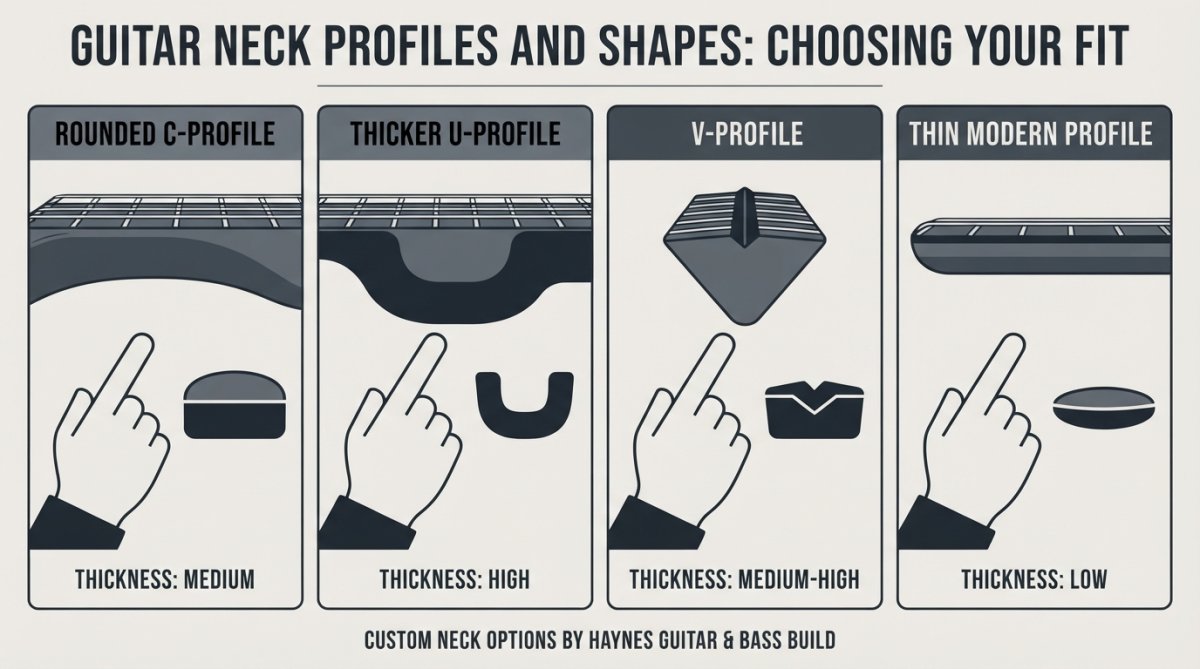
The profile, the cross-sectional shape of the neck, is the single most important specification for comfort. Many players assume all necks feel similar, then spend years playing something that never fits their hands.
Common profiles and their feel:
A C-profile (modern C) is the most forgiving for most players. It's rounded on the back, thinner front-to-back than vintage profiles, and suits both fingerstyle and aggressive picking. Fender's modern Stratocasters use a C-profile. If you're coming from a standard electric guitar, a C-profile is your safe choice.
A U-profile (vintage U) is thicker with rounded shoulders. It's popular among blues and rock players who favour a substantial feel. Gibson Les Pauls use U-profiles. If you have larger hands or prefer a meaty grip, a U-profile offers stability during bends.
A V-profile has a pronounced ridge down the centre, mimicking vintage 1950s Fenders. It's polarising, some find it incredibly comfortable; others find it fatiguing. Try one before committing to a custom replacement.
A thin modern profile (slim taper) is flatter front-to-back and narrower shoulder-to-shoulder. Speed players often prefer this because it reduces finger fatigue during fast runs.
Material selection: Maple, Rosewood, and Beyond
Maple is the industry standard, hard, stable, and bright-sounding. A maple neck with a rosewood fretboard is the classic combination used on Fenders for decades. Rosewood fretboards offer warmth and feel slightly smoother than maple, though rosewood is increasingly restricted due to sustainability concerns.
Some makers offer alternatives to maple. Mahogany necks are slightly softer and warmer-sounding, popular on Gibson-style guitars. Ash necks are bright and resonant. RF Custom offers hard rock maple as standard, with other timber options available on request.
Bolt-On Guitar Neck Replacement UK: Installation Essentials
The vast majority of electric guitars use bolt-on necks, attached via screws through the neck pocket. This makes replacement straightforward compared to glued-in necks (common on Gibsons).
Compatibility checklist for your guitar body:
Before ordering a replacement neck, verify that your new neck will fit your existing body by measuring:
- Neck pocket dimensions: Length, width, and depth. Most Fender-style pockets are standardised (around 85mm × 56mm), but vintage guitars and budget instruments vary.
- Bolt pattern: Count bolt holes and measure spacing. Fender uses 4 bolts; some guitars use 3. Mismatches require drilling new holes.
- Heel width: The widest part where the neck meets the body must fit within your neck pocket without binding.
- Scale length: Distance from nut to bridge. Most guitars are 25.5" (Fender) or 24.75" (Gibson). Scale length must match your body's bridge position.
- Nut width: Standard widths are 42mm, 43mm, or 44mm. Your new neck's nut width must match your preference.
If your body is a standard Fender-style instrument, finding a compatible replacement is straightforward. For budget brands, vintage instruments, or custom builds, contact a luthier for verification before ordering.
DIY vs. Professional Installation
Installing a bolt-on neck yourself is technically possible if mechanically confident. However, misalignment creates stress on bolts and instability. Over-tightening risks cracking the neck heel or stripping threads. If the heel doesn't fit perfectly, you'll need shimming, a precision job.
Most players benefit from professional installation. A luthier will check alignment, test for gaps, shim if necessary, and do a full setup, adjusting truss rod tension, checking fret level, and setting action height. Professional installation costs £80-£200 for straightforward swaps; complex work requiring routing or shimming costs £150-£400.
Guitar Luthier Services UK: Finding the Right Craftsperson
Finding a skilled luthier for your custom neck replacement is crucial. The UK has several excellent specialists with different strengths and lead times.
What to expect during the build process:
A professional luthier begins with a consultation discussing your playing style, hand size, preferred action height, and specific comfort issues. They'll discuss wood options, finish (satin, gloss, oil), fret size (typically 6105 or 6150 crown), and fretboard radius (9.5", 12", or compound).
Once you've agreed on specifications, the luthier provides a lead time estimate and deposit (usually 30-50% of total cost). The build involves roughing out the blank, carving the profile, fretting, finishing, and final inspection. Lead times vary: simple replacement necks ship in 4-6 weeks; fully custom necks with hand-carving take 8-12 weeks or longer.
Lead times and communication standards:
When contacting a luthier, ask:
- What's the current lead time for a new order?
- How often will you receive updates during the build?
- What's the payment schedule?
- What happens if there's an issue during the build?
A luthier who commits to 8-week lead time but delivers in 10 weeks is acceptable. One who quotes 6 weeks, goes silent for 12 weeks, and ships without warning is problematic. Andy Viccars Custom publishes clear pricing and is known for transparent communication. Daniel Alport Guitar Maintenance lists pricing on their website and includes full service with major neck work.
Custom Neck Shaping and Installation: Common Mistakes to Avoid
Many players commission a custom neck with good intentions, then encounter problems during or after installation. Most are avoidable with planning.
Mistake 1: Specifying a profile without playing one first. You read that a V-profile suits your style, order one, and six weeks later hate it. Solution: play multiple profile options before committing. Visit a local guitar shop or luthier and spend time with different profiles.
Mistake 2: Assuming your body's neck pocket is standard. You measure what you think is the pocket width, order a neck, and it arrives slightly too wide. Now you need routing, an extra £100-£200. Solution: have a luthier verify your body's dimensions before ordering.
Mistake 3: Ordering an unfinished neck without a finishing plan. Unfinished necks are cheaper (£150-£300 vs. £400-£800), but require staining, sealing, and finishing work. If you don't have a plan, you'll pay a luthier to do it anyway, erasing the cost saving. Solution: only order unfinished if confident finishing it yourself or have a luthier lined up.
Mistake 4: Not accounting for setup time after installation. A new neck needs full setup: truss rod adjustment, fret levelling, action adjustment, intonation checking. If your luthier doesn't include this, budget an extra £80-£150. Solution: confirm installation includes full setup before paying.
Troubleshooting fit and intonation issues:
Common issues after installation include:
- Neck angle too steep or shallow: Action is too high or low across the board. Usually means misaligned pocket or missing shimming. A luthier can adjust shims or rout the pocket slightly.
- Frets buzz on certain strings: The neck might have a slight twist or individual frets might be high. This requires fret dressing (£60-£150).
- Intonation won't set correctly: The bridge saddle is too far forward or back, usually indicating scale length mismatch or incorrectly positioned bridge.
- Neck pocket too loose: The new neck's heel is slightly too narrow. Shims can tighten the fit; rarely, the pocket might need padding.
Most issues are fixable by a competent luthier. Have a full setup done immediately after installation and address problems early.
Maintenance and care after replacement:
A new neck requires the same care as any guitar neck. Keep it away from extreme humidity swings (relative humidity should stay between 40-50%). Oiled finishes need occasional re-oiling (every 6-12 months); lacquered finishes need dusting and occasional polish. Frets should be cleaned regularly to prevent oxidation.
If you've invested in a custom neck, protect that investment with proper storage and maintenance. A humidified case and regular cleaning will keep it stable and playable for decades.
Tone Impact and Long-Term Playability
Does a custom neck change tone? Yes, but subtly. A thicker, stiffer neck (like a U-profile) tends to have slightly more sustain and marginally brighter tone than a thin, flexible neck. However, the effect is small, perhaps 5-10% of overall tone. The body, pickups, and electronics contribute far more.
What a custom neck absolutely changes is playability. A neck that fits your hands perfectly reduces fatigue, allows faster playing, and makes bending more comfortable. Better playability means you'll play longer with more confidence, translating to better tone production through technique.
Long-term, a well-crafted custom neck holds its value and playability for decades. Properly maintained, it won't warp, twist, or develop fret wear beyond normal playing. This is why investing in quality replacement pays dividends over time.
A custom guitar neck replacement service solves real problems: a neck that doesn't fit your hands, structural damage that repair can't fix, or the desire to upgrade a budget instrument. The UK has excellent luthiers and makers ready to build exactly what you need. Start by clarifying your specifications, profile, materials, scale length, then contact makers like RF Custom, Noden Guitars, or McIntyre Guitars. For a fully bespoke instrument where the neck is part of a complete custom build, Haynes Guitar & Bass Build offers hand-crafted guitars starting at £3,200, including a custom-profiled neck, hand-wound pickups, and a body tailored to your exact tone and comfort specifications. Whether retrofitting an existing guitar or building from scratch, the right neck transforms how your instrument plays.
Frequently Asked Questions
How much does a custom guitar neck replacement cost in the UK?
Pricing varies significantly based on complexity and materials. Hand-built custom necks from specialist luthiers typically start around £800-£1,500 for standard specifications. Full custom builds with bespoke shaping, premium timber selection, and installation labour can exceed £2,000. Haynes Guitar & Bass Build offers custom-built guitars from £3,200, which include hand-wound pickups and fully customisable necks. Always request a detailed quote that specifies materials, lead time, and installation costs separately.
What should I consider when choosing a custom guitar neck for bolt-on replacement?
Verify neck pocket dimensions, bolt pattern spacing, and heel shape compatibility with your guitar body. Check the scale length (typically 24.75 inches for Les Paul-style, 25.5 inches for Fender-style). Decide on neck profile (C, U, or V-shape), fretboard radius (9.5 inches, 12 inches, or compound), and wood species. Consider nut width (typically 1.5-1.69 inches) and whether you want an unfinished or finished neck. A DIY compatibility checklist should include measuring your existing neck pocket before ordering.
How long does a custom guitar neck replacement take in the UK?
Lead times depend on the luthier's workload and customisation level. Standard bolt-on replacements with stock specifications typically take 6-12 weeks. Fully custom necks with hand-shaping, specific timber sourcing, and finish work can take 12-20 weeks. Haynes Guitar & Bass Build and similar UK specialists recommend contacting them directly for current build times, as these vary seasonally. Always confirm lead times in writing before committing, and ask about progress updates during the build process.
Can I install a custom guitar neck myself, or do I need a luthier?
Bolt-on neck installation is achievable for experienced DIY builders with proper tools (drill, screwdrivers, shims, feeler gauges). However, professional luthier installation is recommended if you lack experience with neck pocket shaping, truss rod adjustment, or intonation setup. A luthier ensures correct alignment, proper action height, and playability. Installation costs typically range from £100-£300. If you're building your first partscaster, professional installation is worth the investment to avoid costly mistakes.
This article was written using GrandRanker