

Hand Wound vs Machine Wound Pickups: The Real Difference
Table of Contents
- Hand Wound vs Machine Wound Pickups: What's the Actual Difference?
- Pickup Manufacturing Process: From Bobbin to Finished Coil
- Scatter Wound Pickups Explained: The Art of Randomness
- Pickup Tone Differences: Does Winding Method Actually Matter?
- Wire Gauge, Insulation, and Formvar: The Technical Details That Shape Tone
- Boutique Guitar Pickups UK: Hand-Wound Craftsmanship vs. Factory Consistency
- Consistency vs. Character: The Trade-Off Explained
- Cost, Lead Times, and Practical Considerations
Last Updated: July 27, 2026
Hand Wound vs Machine Wound Pickups: What's the Actual Difference?
Hand winding introduces subtle variations in tension, wire spacing, and scatter patterns that machine winding cannot replicate. These variations affect capacitance, inductance, and how your pickup responds to string vibrations. Hand-wound pickups tend toward warmer, more expressive tones with increased harmonic complexity. Machine-wound pickups offer predictable output and tighter frequency response. Neither is objectively "better", the choice depends on what your instrument and playing style demand.
Defining Hand-Wound and Machine-Wound Construction
Hand-wound pickups are wound by a craftsperson who guides copper wire around a bobbin by hand, controlling tension and spacing throughout. Machine-wound pickups use automated winding heads that follow precise programmed parameters.
A hand-winding operator can feel the tension on the wire, adjust for variations in the bobbin, and vary the scatter pattern, the random spacing of wire layers, to influence how the magnetic field interacts with strings. A CNC machine follows its programme exactly the same way every time.
According to Bare Knuckle Pickups' technical documentation, hand-wound pickups introduce subtle inconsistencies in winding tension and spacing that create unique tonal characteristics. These aren't flaws; they're features that contribute to the pickup's personality.
Pickup Manufacturing Process: From Bobbin to Finished Coil
Hand-Winding Techniques and Tension Control
Hand winding begins with a bobbin, the plastic or ceramic form around which wire wraps. The operator feeds 42-43 AWG copper wire through a tension device, then guides it manually around the bobbin. A typical Stratocaster pickup requires 6,500-7,500 turns, taking an experienced winder 45 minutes to an hour.
Tension control is where hand winding becomes an art. Too much tension and the wire breaks; too little and the coil becomes loose and microphonic. Experienced winders develop a feel for the sweet spot, usually around 150-250 grams of tension. This tension affects how tightly the wire sits, influencing capacitance and the pickup's high-end response.
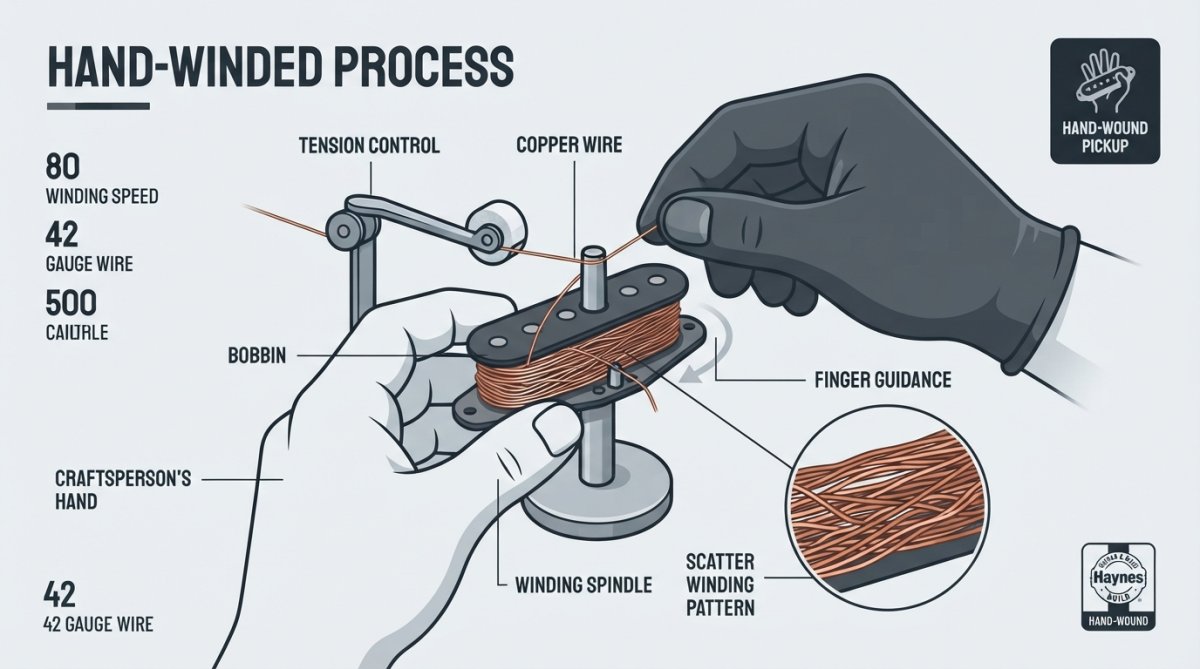
Scatter winding, the deliberate or semi-random spacing of wire layers, happens naturally during hand winding. As the operator moves the wire back and forth across the bobbin, slight variations in hand speed and positioning create uneven distribution. This scatter pattern breaks up resonant peaks in the coil's frequency response, contributing to smoother tone.
CNC Machine Winding and Modern Automation
Machine winding uses a CNC head that positions the wire with mechanical precision. The bobbin rotates at a fixed speed while the wire guide moves back and forth in a programmed pattern. Modern machines can wind a Stratocaster coil in 15-20 minutes, achieving identical results every time.
The advantage is consistency: every pickup from a batch has the same turn count, wire spacing, and capacitance. Some modern CNC machines can now be programmed to introduce scatter patterns, combining machine consistency with hand-wound character, though the effect is subtly different from true hand-wound scatter.
Scatter Wound Pickups Explained: The Art of Randomness
Scatter winding, the uneven, semi-random distribution of wire across the bobbin, is one of the most misunderstood aspects of pickup construction. It's not a defect; it's a fundamental characteristic that shapes how a pickup sounds.
Uniformity vs. Randomness in Winding Patterns
Uniform winding places each layer of wire in a tight, organised pattern, maximising turn count and producing predictable inductance and capacitance. Scatter winding deliberately offsets each layer, leaving small gaps between wire passes. A hand-wound coil naturally develops scatter as the operator's hand speed varies.
This scatter pattern has a measurable effect on tone. The gaps between wire layers reduce parasitic capacitance, the unwanted capacitive coupling between adjacent wire turns. Lower capacitance means the pickup's natural resonant peak shifts slightly higher in frequency, contributing to increased clarity and reduced mud in the midrange.
How Scatter Winding Influences Capacitance and High-End Response
Capacitance in a pickup coil is determined by wire gauge, insulation thickness, coil diameter, and spacing between wire turns. Scatter winding directly influences that spacing.
Research from Seymour Duncan's pickup design documentation shows that reducing inter-layer capacitance by 10-15% can shift a pickup's resonant peak from 3.5 kHz to 4.2 kHz. That shift is subtle but audible, adding presence and definition without introducing harshness.
A hand-wound coil with scatter typically exhibits a gentler roll-off in high frequencies, preserving string articulation and pick attack. A machine-wound uniform coil often has a sharper peak at resonance followed by a steeper roll-off, which some players perceive as less natural.
Pickup Tone Differences: Does Winding Method Actually Matter?
In a blind listening test with identical amplification and recording setup, most listeners can detect a difference between hand-wound and machine-wound pickups from the same manufacturer. Hand-wound versions typically sound warmer, with more pronounced midrange and slightly softer high-end response. Machine-wound versions sound tighter and more defined.
However, those differences are often smaller than differences between pickup types (Strat vs. Tele vs. humbucker), magnet types (Alnico vs. ceramic), or winding specs (5,000 turns vs. 7,500 turns).
Warmth, Clarity, and Harmonic Content Comparison
Hand-wound pickups tend toward warmth because of their scatter winding pattern and natural variations in tension that create subtle impedance variations throughout the coil. These variations smooth out harsh resonances and create a more forgiving, organic tone with richer harmonic content in the 2-4 kHz range.
Machine-wound pickups with uniform winding often exhibit a more pronounced peak at the coil's resonant frequency. This peak adds clarity and definition for lead playing and cutting through a mix.
Magnetic Field Behaviour and Coil Geometry
A scatter-wound coil has a slightly less uniform magnetic field because wire distribution is uneven. This produces a more complex interaction with the vibrating string, generating more harmonic overtones. A uniform machine-wound coil produces a more symmetrical magnetic field, resulting in a cleaner, more linear response.
Wire Gauge, Insulation, and Formvar: The Technical Details That Shape Tone
Copper Wire Specifications and Enamel Coating
Most guitar pickups use 42 or 43 AWG copper wire. Thinner wire allows more turns in the same space, increasing inductance and output. Thicker wire reduces turn count but increases resistance and can warm up the tone.
The insulation, typically formvar enamel or polyurethane, affects the wire's electrical properties. Formvar insulation is thinner, allowing tighter coil packing. Polyurethane insulation is thicker, requiring more space between turns. This difference directly affects capacitance and frequency response.
Vintage Fender pickups used formvar wire because it was standard in the 1950s. Modern pickups often use polyurethane because it's more durable. The tonal difference is subtle but real, formvar-wound pickups typically sound slightly brighter due to lower inter-turn capacitance.
Mojo Pickups' wire specification guide documents how wire gauge and insulation type influence output impedance and frequency response. A shift from 42 to 43 AWG can increase turn count by 8-10%, raising output by approximately 0.5-1.0 dB and warming the tone slightly.
Impedance, Inductance, and Frequency Response
A pickup coil is an inductor; its impedance varies with frequency. At low frequencies, a pickup coil has low impedance and passes signal easily. At high frequencies, impedance increases, progressively attenuating the signal. This creates the pickup's natural roll-off in the treble region.
Inductance is determined by coil geometry and turn count. More turns equal higher inductance and lower resonant frequency, making the pickup sound warmer and darker. Hand-wound and machine-wound coils with identical turn counts have nearly identical resistance and inductance. The differences in tone come from scatter winding's effect on capacitance.
Boutique Guitar Pickups UK: Hand-Wound Craftsmanship vs. Factory Consistency
The UK boutique pickup market has embraced hand winding as a core value proposition, with makers like Bare Knuckle, Mojo, and Haynes Guitar & Bass Build positioning hand-wound construction as a marker of quality and character.
Why UK Makers Favour Hand-Winding
UK boutique makers favour hand winding because it allows customisation, a customer can request specific scatter patterns, wire gauges, or output levels. Hand winding also creates a narrative of craftsmanship that resonates with players seeking alternatives to mass production. The tonal character of hand-wound pickups aligns with the vintage-inspired aesthetic that dominates the UK guitar market.
Bare Knuckle Pickups winds every pickup by hand and markets that fact prominently. Hand-wound boutique pickups command 40-60% price premiums over machine-wound alternatives.
Haynes Golden Root Pickups: A Case Study in Hand-Wound Design
Haynes Guitar & Bass Build's Golden Root pickup series exemplifies the hand-wound approach. Each set is wound to vintage specifications using formvar-insulated 42 AWG wire, with scatter winding that mimics 1950s Fender construction.
The Haynes Golden Root 1957 Stratocaster set (£89.00) uses approximately 6,500 turns with Alnico V magnets, producing output around 6.2 dBm. The hand-wound construction contributes a perceived smoothness in the midrange that players consistently report. The Haynes Golden Root 62 Jazz Bass pickups (£105.00) and P51 Bass pickup (£95.00) emphasise articulation and string definition. The Telecaster Blackguard set (£110.00) targets the aggressive, snappy tone of vintage Fender Tele pickups.
What distinguishes Haynes Golden Root pickups is consistency of approach rather than hand-wound perfection. Each pickup is wound by experienced makers who understand how scatter patterns influence tone, applying that knowledge systematically across production runs.
Consistency vs. Character: The Trade-Off Explained
The fundamental trade-off between hand-wound and machine-wound pickups is consistency versus character.
Machine-Wound Consistency and Quality Control
Machine-wound pickups achieve consistency through automation and measurement. Every pickup from a batch is wound with identical parameters, producing identical inductance, capacitance, and resistance. Quality control is systematic: sample pickups are measured for output, resonant frequency, and impedance.
This consistency is valuable because replacement pickups match originals exactly and tone is predictable. The downside is that consistency can feel sterile, every pickup sounds identical, which some players perceive as a loss of musicality.
Hand-Wound Variation and the Vintage Appeal
Hand-wound pickups embrace variation as a feature. No two pickups are identical, even from the same maker on the same day. This variation is what players call "character." Vintage Fender pickups from the 1950s are prized because each one is slightly different, and that variation contributes to the perception of musicality and warmth.
The downside is unpredictability. You can't guarantee a replacement hand-wound pickup will match your original exactly. For recording, where consistency is valuable, machine-wound pickups are often preferred. For live performance, where character matters more than uniformity, hand-wound pickups shine.
Cost, Lead Times, and Practical Considerations
Hand-wound pickups cost more to produce. Labour is the primary driver, a skilled winder earns £18-25 per hour in the UK, and winding a single pickup takes 45-60 minutes. A hand-wound pickup that costs £85-110 retail requires approximately £20-25 in labour alone, plus materials and overhead.
Machine-wound pickups require capital investment in equipment. A CNC winding machine costs £15,000-40,000, justified only for high-volume production. For small makers, hand winding is more economical.
Lead times reflect this economics. Machine-wound pickups from established manufacturers are typically in stock or available within 2-4 weeks. Hand-wound boutique pickups often have 4-12 week lead times because they're made to order. Haynes Guitar & Bass Build winds pickups in batches and can accommodate custom orders within 6-8 weeks.
| Consideration | Hand-Wound | Machine-Wound |
|---|---|---|
| Tone Character | Warm, organic, complex harmonics | Clean, defined, linear response |
| Consistency | Variation within acceptable range | Identical across batches |
| Cost | £85-169 per pickup | £50-99 per pickup |
| Lead Time | 4-12 weeks (custom order) | 2-4 weeks (stock) |
| Customisation | Easy, adjust tension, scatter, specs | Limited, standard specs only |
| Quality Control | Listening tests, spot checks | Automated measurement, 100% sampling |
| Best For | Tone seekers, vintage enthusiasts | Budget-conscious, consistency-focused |
The hand wound vs machine wound pickups debate persists because both approaches have genuine merit. Hand-wound pickups offer character and customisation that appeals to players seeking vintage tone and craftsmanship. Machine-wound pickups deliver consistency and value for working musicians and budget-conscious buyers.
At Haynes Guitar & Bass Build, we've built our reputation on hand-wound pickups that combine character with reliability. The Haynes Golden Root series proves that hand winding doesn't require sacrificing consistency. If you're seeking pickups that capture vintage tone without the unpredictability of true vintage originals, hand-wound boutique pickups from UK makers like Haynes offer the best of both worlds. Start exploring the Haynes Golden Root pickup sets and hear the difference hand-wound construction makes.
Frequently Asked Questions
What is the difference in tone between hand-wound and machine-wound pickups?
Hand-wound pickups typically deliver warmer, more organic tones with richer harmonic content due to subtle variations in winding tension and wire spacing. Machine-wound pickups offer tighter, more consistent tones with enhanced clarity and reduced microphonic noise. The difference stems from coil geometry, capacitance, and how the magnetic field interacts with the copper wire. Hand-wound scatter winding patterns create unique frequency response characteristics that many players associate with vintage character.
Are hand-wound pickups truly better than machine-wound pickups?
Not universally. Hand-wound pickups excel at delivering vintage-inspired warmth and dynamic responsiveness, making them ideal for blues, classic rock, and players seeking expressive tone. Machine-wound pickups provide superior consistency, reliability, and modern clarity, advantages for metal, modern rock, and session work. The 'better' choice depends on your tone goals, budget, and playing style. Haynes Golden Root hand-wound pickups, for example, prioritise vintage specifications and tonal character over mass-production efficiency.
What is scatter winding and how does it affect pickup tone?
Scatter winding is a hand-winding technique where copper wire is wound randomly across the bobbin rather than in perfectly aligned layers. This randomness reduces capacitance, extends high-end frequency response, and creates a more natural, less sterile tone. Scatter winding also minimises microphonic feedback and improves touch sensitivity. Machine-wound pickups typically use uniform winding patterns for consistency. The scatter wound approach is particularly valued in boutique guitar pickups UK makers like Haynes, where tonal nuance takes priority over production speed.
Do hand-wound pickups have better frequency response than machine-wound?
Hand-wound scatter winding typically delivers extended high-end clarity and smoother midrange response due to lower capacitance and optimised coil geometry. Machine-wound pickups, while highly consistent, can exhibit slightly tighter high-frequency response. However, modern CNC machines now achieve impressive frequency response control. The real difference lies in character: hand-wound pickups often sound more organic across the frequency spectrum, while machine-wound pickups prioritise tonal precision and predictability across multiple units.
Why are hand-wound pickups more expensive than machine-wound alternatives?
Hand-winding is labour-intensive, requiring skilled craftspeople to control tension, wire spacing, and scatter patterns manually. Production is slower, lead times are longer, and material waste is higher. Machine-wound pickups benefit from economies of scale and automation, reducing per-unit costs significantly. A Haynes Golden Root hand-wound pickup set costs £89-£110, reflecting UK craftsmanship and materials, whilst mass-produced machine-wound alternatives often cost £40-£60. The premium reflects artisan labour, quality control, and the bespoke nature of the winding process.
This article was written using GrandRanker