

How to Improve Guitar Resonance: 7 Key Upgrades
Table of Contents
- Understanding Guitar Resonance: Why It Matters
- String Gauge and Tension: Foundation for Guitar Sustain Improvement
- Guitar Setup for Resonance: Precision Adjustments
- Guitar Tonewoods and Resonance: Material Selection
- Bridge and Saddle Upgrades: Vibration Transfer Mechanics
- Hardware Stability and Sympathetic String Resonance
- DIY vs. Professional Luthier Work: When to Upgrade Yourself
- Common Mistakes That Kill Guitar Resonance
How to Improve Guitar Resonance: 7 Key Upgrades
Last Updated: August 1, 2026
Understanding how to improve guitar resonance separates instruments that sing from those that merely make noise. At Haynes Guitar & Bass Build, we've spent years examining what transforms a guitar's tone from flat and lifeless into something that sustains, projects, and captures the full harmonic content a player deserves. Resonance isn't magic, it's physics, precision, and deliberate choices about materials, setup, and hardware.
Resonance is the result of vibrational energy moving efficiently through your instrument's structure, then decaying at the right rate to create sustain and richness. Most guitarists chase resonance by accident, upgrading pickups or trying expensive woods without understanding the actual mechanics at play. This guide shows you exactly what controls resonance and which upgrades actually work.
Understanding Guitar Resonance: Why It Matters
Resonance is the instrument's ability to vibrate freely and sustain sound after you've struck a string. A resonant guitar holds notes longer, projects more volume without amplification, and develops richer harmonic content as vibration travels through the body. This matters whether you play acoustic or electric, though the physics differ.
Acoustic vs. Electric Physics
Acoustic guitars rely on the wooden body as a resonance chamber. When you pluck a string, that vibration transfers through the bridge into the top, back, and sides. A well-built acoustic sustains a note for 10-15 seconds or more.
Electric guitars work differently. The string vibration is captured magnetically by pickups, not acoustically by wood. However, a dense, well-constructed body with good acoustic coupling (the connection between neck and body) will sustain longer than a poorly built one, even through an amplifier. The key distinction: acoustic resonance depends on air movement and wood vibration, while electric resonance is about minimizing mechanical energy loss.
Measuring Resonance: Beyond Ear Training
Decay time is the most practical measurement. Strike a string and count how many seconds until it becomes inaudible. A good electric guitar sustains 8-12 seconds on the high E string. If your guitar drops below 6 seconds, something is dampening vibration unnecessarily.
Frequency response testing uses a spectrum analyser to reveal which frequencies your guitar emphasizes and which it suppresses. A "dead spot" is a frequency where the body stops vibrating efficiently, causing that note to drop out suddenly.
Tap testing is simpler: tap different parts of the guitar body and listen to the ring. A resonant body rings clearly; a dead body produces a dull thud.
String Gauge and Tension: Foundation for Guitar Sustain Improvement
String gauge and tension form the foundation for sustain. Thicker strings carry more vibrational energy and force that energy through the instrument more efficiently. A .046 wound string vibrates differently than a .036, the heavier string has more mass and transfers energy more completely into the guitar's structure.
Heavier gauges (.011-.054 or thicker) improve sustain noticeably but sacrifice playability. Lighter gauges (.009-.042) sacrifice sustain for ease of bending. The sweet spot for most players is .010-.046 or .011-.049, balancing sustain improvement with reasonable playability.
Total tension across all six strings matters too. A full set of .010s generates roughly 120-130 pounds total; a .011-.054 set hits 145-160 pounds. That difference affects playability and how the neck bends under load.
Guitar Setup for Resonance: Precision Adjustments
Setup is where most hobbyists fail. A perfectly built guitar with poor setup will sound dead. Setup controls how efficiently vibration transfers from string to instrument.
Nut Slot Depth and Material Quality
The nut is where the string's vibration enters the guitar. Slots cut too deep dampen the string's motion; slots cut too shallow cause buzzing. Bone is the standard for good reason, it's dense, stable, and transmits vibration efficiently. Plastic nuts are inferior. Tusq (synthetic bone) is acceptable and more stable than bone in humid climates.
A bone nut is a worthwhile investment. Expect to pay £15-40 for a quality blank and either have a luthier slot it (£30-60 labour) or learn to do it yourself.
Action Height and Dampening Effects
Action is the distance between strings and fretboard. High action (over 2.5mm on the bass side) allows strings to vibrate more freely but makes bending difficult. Low action (under 1.5mm) feels easier but risks fret buzz, which dampens vibration and steals sustain.
Optimal action for most players is 1.75-2.0mm on the bass side, 1.5-1.75mm on the treble side. This clears frets while allowing comfortable play and efficient vibration transfer.
Neck Pocket Contact and Acoustic Coupling
On bolt-on neck guitars, tight contact between neck and body means vibrations travel efficiently through the entire instrument. Check the neck pocket from the body side, you should see contact across the entire mating surface. If you see light gaps, the pocket needs routing or the neck needs shimming.
Guitar Tonewoods and Resonance: Material Selection
Wood species affect resonance through density, grain structure, and how vibrations propagate. Denser woods (like mahogany, maple, or rosewood) carry vibrations more efficiently than softer woods (like alder or ash). A dense body sustains longer and projects more volume.
The frequency response effect is subtle. Mahogany emphasizes midrange and lower frequencies, giving a warmer tone. Maple emphasizes treble, creating brightness. On electrics, pickups shape tone more than wood, but wood still contributes to sustain and harmonic complexity.
For resonance specifically, density matters more than species. Properly seasoned wood resonates better than green or overly dry wood. This is why quality guitar makers age their wood, it stabilizes, densifies slightly, and resonates more predictably.
The neck's mass and stiffness also influence how the entire instrument vibrates. A substantial neck with good bracing resists bending and transmits vibrations more efficiently to the body.
Bridge and Saddle Upgrades: Vibration Transfer Mechanics
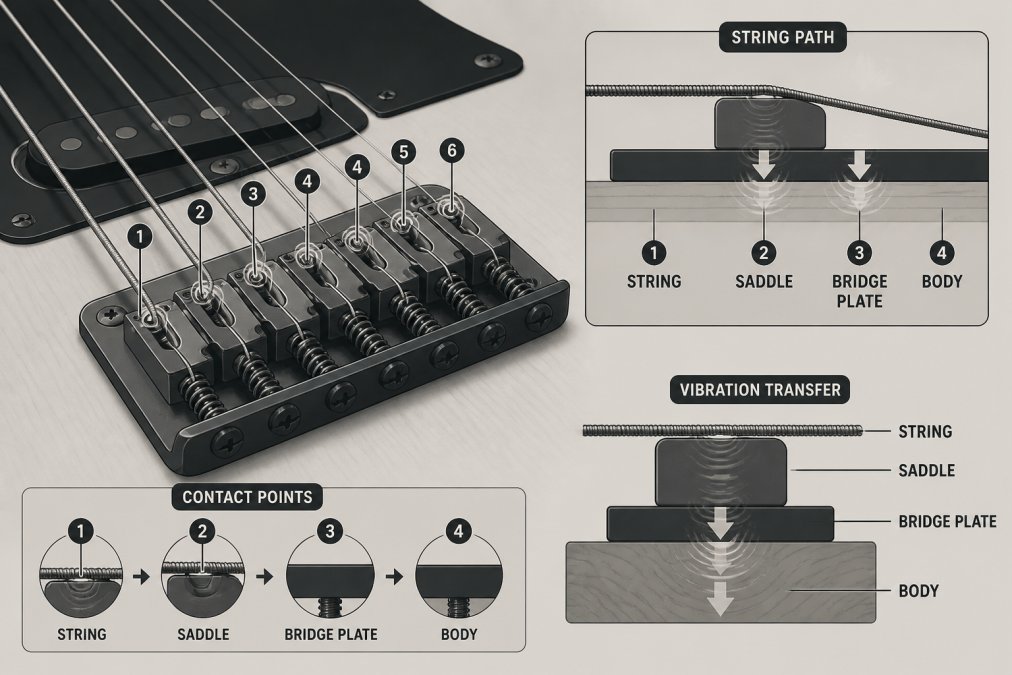
The bridge is where string vibration transfers into the body. Every element matters: material, mass, contact area, and how strings sit on the saddle.
Saddle Material and Frequency Transfer
Bone is the standard for good reason, it's dense, stable, and transmits vibrations efficiently across a wide frequency range. Plastic saddles are noticeably inferior, dampening high frequencies and reducing sustain by 1-2 seconds compared to bone.
Tusq is a synthetic bone alternative that's slightly harder than bone and very stable. For a replacement saddle, expect £8-15 for Tusq, £6-12 for bone. The saddle's height and angle also matter, poor contact reduces energy transfer.
Bridge Mass and Decay Time
A heavier bridge sustains longer than a light one. The mass acts as a mechanical anchor, forcing more vibration into the body rather than allowing the string to move freely in space.
A hardtail bridge with substantial mass improves sustain noticeably. Tremolo bridges are lighter and more complex, which can reduce sustain slightly. A quality tremolo with proper setup can still achieve good sustain, the mechanism's stability matters more than raw mass.
| Bridge Type | Sustain Advantage | Best For |
|---|---|---|
| Hardtail Fixed | Highest | Lead playing, tone focus |
| Quality Tremolo | Good | Expressive playing, vibrato |
| Vintage-style | Moderate | Vintage tone, simplicity |
Hardware Stability and Sympathetic String Resonance
Hardware includes tuning machines, bridge posts, strap buttons, and any metal components that attach the neck or secure the bridge. Loose or poorly designed hardware introduces unwanted vibration loss.
Tremolo Block Mass and Resonance Frequency
On guitars with floating tremolo systems, the tremolo block (the metal mass behind the bridge) is critical for sustain. A heavier block resists the bridge's movement and forces more vibration into the body. Floyd Rose blocks come in standard and heavier versions. Upgrading to a heavier block can add 1-2 seconds of sustain, particularly on lower strings, for £20-40.
String Trees and Mechanical Energy Loss
String trees are small posts that hold higher strings down at the headstock, controlling their angle into the nut. Cheap or poorly designed string trees introduce friction, which dampens vibration. Quality string trees (often made from bone or Tusq) reduce friction compared to plastic ones. Cost is minimal (£5-10 per tree).
DIY vs. Professional Luthier Work: When to Upgrade Yourself
Some resonance improvements are straightforward DIY tasks. Others require specialized tools and expertise.
Safe Modifications for Hobbyists
String gauge changes are completely safe and take 5-10 minutes. Hardware tightening is completely safe and takes 10 minutes. Bridge replacement (on guitars where the bridge is bolted on) is straightforward if you maintain the correct angle and height. Mark the original position before removing the old bridge. Cost is £30-80 for a quality replacement bridge.
Nut and saddle replacement is possible if you're comfortable with files and gauges, but it's easy to ruin a nut by cutting slots too deep or at the wrong angle. A luthier will charge £30-60 labour, which is reasonable insurance against a £50+ mistake.
When to Seek Professional Help
Nut slotting should be done by a professional if you lack experience. A poorly cut nut will buzz, affect intonation, and ruin playability. Neck pocket routing requires precision tools and expertise, a mistake here is catastrophic. Fret work requires specialized equipment and skill. For a custom build, Haynes Guitar & Bass Build can handle technical aspects, proper routing, hardware installation, setup, and testing.
Common Mistakes That Kill Guitar Resonance
Most players inadvertently reduce their guitar's resonance through simple mistakes.
The Dead Spot Phenomenon Explained
A dead spot is a frequency where the guitar's body stops vibrating efficiently, causing notes at that frequency to drop out suddenly or sound noticeably duller. Dead spots are caused by the body's resonance frequency interacting destructively with the vibrating string.
Fixing a dead spot requires either changing the body's resonance frequency through mass distribution or internal bracing (luthier work), or playing around the dead spot. Some players add mass to the body (lead tape on the inside of the back) to shift the resonance frequency away from problem areas. This is a DIY experiment costing £5-10 with low risk.
Over-Dampening and Lost Sustain
Common causes include excessive finger pressure (gripping the fretboard too hard dampens string vibration), foam or rubber inside the body, worn or damaged strings, poor setup, and cheap or loose hardware.
| Problem | Symptom | Fix | DIY-Friendly |
|---|---|---|---|
| Worn strings | Dull tone, short sustain | Replace strings | Yes |
| Fret buzz | Sustain drops suddenly | Professional setup | No |
| Loose hardware | Rattle or vibration | Tighten all bolts | Yes |
| Dead spot | Specific frequency dies | Add internal mass | Experimental |
| Over-dampening | Overall dull tone | Remove internal foam | Yes |
Improving guitar resonance combines understanding physics, making deliberate upgrades, and eliminating mistakes. The most impactful changes, tight acoustic coupling, proper setup, quality strings, and hardware stability, cost little or nothing. The next tier (bridge and saddle upgrades, string gauge optimization) costs £30-100 and yields measurable improvements.
If you're building a custom instrument or upgrading a partscaster, Haynes Guitar & Bass Build specializes in hand-built guitars designed specifically for superior resonance and tone. Our custom necks feature optimized mass and bracing, our bridges are engineered for maximum sustain, and our hand-wound pickups capture the full harmonic content your resonant guitar produces. Whether you're assembling components yourself or commissioning a full build, we work with you to ensure every element supports your resonance goals. Discover how precision craftsmanship transforms tone at Haynes Guitar & Bass Build.
Frequently Asked Questions
What makes a guitar more resonant?
Guitar resonance depends on several interconnected factors: tonewoods with appropriate body density, hardware stability that minimizes energy loss, proper setup with correct nut slots and saddle material, and string gauge that optimises vibrational energy transfer. The neck-to-body joint contact and bridge mass also significantly influence how long notes sustain and how clearly harmonic content projects. Each element affects the overall acoustic coupling of the instrument.
How can I improve guitar sustain improvement without professional help?
Start with string gauge: moving to slightly heavier strings increases mechanical energy and sustain. Next, check your action height and nut slots, excessive dampening kills resonance. Upgrade your bridge saddle to bone or quality synthetic material for better frequency transfer. Ensure your tremolo block (if fitted) has adequate mass. Finally, verify your neck pocket makes full contact with the body. These adjustments address vibration transfer directly and are achievable for DIY builders.
What is the dead spot phenomenon in guitars?
A dead spot is a fret or frequency where the guitar suddenly loses sustain or resonance, the note dies prematurely instead of ringing out. This typically results from poor neck-to-body joint contact, a misaligned tremolo block, or hardware that vibrates at a conflicting resonance frequency. The vibration gets absorbed or cancelled rather than transferred to the body. Professional luthiers diagnose dead spots by measuring resonance frequency at different points and adjusting hardware mass or joint contact accordingly.
Does guitar setup for resonance differ between acoustic and electric guitars?
Yes, significantly. Acoustic guitars rely entirely on body vibration to project sound, so tonewoods, bracing, and bridge mass are critical. Electric guitars depend on pickups to capture string vibration, but resonance still matters, better sustain means more harmonic content for the pickups to capture. Setup principles overlap: nut quality, action height, and neck pocket contact affect both. However, electric guitars benefit more from hardware stability and tremolo block mass, while acoustics prioritise tonewood density and acoustic coupling.
This article was written using GrandRanker