

Hand-Wound Pickups: Why Choose Them Over Machine-Made
Table of Contents
- Why Choose Hand-Wound Pickups: The Core Difference
- Hand-Wound vs Machine-Wound Pickups: Manufacturing Reality
- Scatter-Wound Pickups and Tone Profile
- Guitar Pickup Winding Techniques: The Craft Behind the Sound
- Vintage Guitar Tone: PAF Legacy and Modern Hand-Wound Design
- The Mojo Factor: Separating Tone Reality from Marketing Myth
- Is the Investment in Hand-Wound Pickups Worth It?
- Conclusion: Making the Hand-Wound Choice
Last Updated: July 26, 2026
Why Choose Hand-Wound Pickups: The Core Difference
Hand-wound pickups wrap copper wire around a magnetic bobbin in a controlled but non-uniform pattern, differing fundamentally from machine-wound pickups that use automated systems for mechanical precision. Winding tension, wire distribution, and coil geometry directly influence how a pickup responds to string vibration and translates it into electrical signal.
According to vintage guitar research from the Vintage Guitar Museum, scatter-wound pickups used in 1950s and 1960s PAF designs became the sonic benchmark because their irregular winding patterns created natural harmonic complexity. Modern hand-wound construction deliberately recreates these characteristics.
What Makes Hand-Wound Construction Unique
Hand-wound winding allows deliberate variation in how copper wire layers onto the bobbin, creating measurable differences. First, capacitance shifts depending on how tightly adjacent wire wraps sit against each other, affecting high-end frequency response and whether a pickup sounds bright, balanced, or warm.
Second, scatter-wound patterns distribute the magnetic field more organically across the coil. A perfectly uniform winding creates resonance peaks at specific frequencies that can sound clinical. Scatter winding spreads resonance across a broader frequency range, which many players perceive as more "musical" or "organic."
Winding tension also affects microphonics, how much a pickup picks up vibration from the coil itself rather than just the strings. Looser winding typically reduces microphonics; tighter winding can increase it, which some players prefer for added responsiveness.
Hand-Wound vs Machine-Wound Pickups: Manufacturing Reality
Machine-wound pickups offer consistency: every coil winds identically with matching tension and specifications. Hand-wound pickups sacrifice absolute consistency for tonal flexibility, allowing fine-tuning of tone within a specified range.
Research from [guitar electronics(https://avhkbx-bp.myshopify.com/blogs/news/how-to-upgrade-guitar-electronics) engineering guides published by Guitar Electronics Supply | guitarelectronics.com] shows both approaches deliver excellent results when executed with care. The critical variables are specifications, wire gauge, coil turns, magnet type, and bobbin geometry, which matter far more than the winding method alone.
Tension Control and Coil Geometry
Hand-wound construction allows winders to adjust tension dynamically, creating tighter wraps in some areas and looser wraps in others. This produces a coil with variable impedance that affects how the pickup's magnetic field couples with string vibration, creating more complex harmonic response.
Machine-wound pickups maintain constant tension throughout, creating uniform coil geometry and predictable, linear impedance. The advantage is consistency; the trade-off is a more linear tone profile with less complexity.
For vintage tone, particularly the warm, slightly compressed character of 1950s and 1960s PAF pickups, variable impedance and scatter-wound geometry are essential.
Consistency and Variation
Hand-wound pickups introduce intentional variation within bounded ranges. The best hand-wound manufacturers use bobbin guides, tension-monitoring systems, and wire-feed controls to maintain specifications. Hand-wound pickups typically show DC resistance within 2-3% across a production batch, while machine-wound pickups tighten to 0.5-1%. Both ranges are acceptable; the question is whether tighter consistency matters for your application.
For replacement pickups, consistency ensures the new pickup matches the original's tonal character. For custom builds, intentional variation is an advantage.
Scatter-Wound Pickups and Tone Profile
Scatter-wound construction uses non-uniform wire distribution across the bobbin, with wire wrapping at varying angles and tensions. This irregularity affects the pickup's tone profile, typically producing:
- A broader, less pronounced resonance peak
- More harmonic content in the midrange (2-4 kHz)
- Softer high-end roll-off
- More dynamic range and sensitivity to pick attack variations
These characteristics defined classic rock and blues guitar sounds.
How Winding Patterns Affect Capacitance and High-End Frequency Response
Scatter-wound patterns create variable spacing between wire wraps. The overall capacitance of a scatter-wound coil is typically 5-15% lower than a uniformly wound coil with the same specifications. Lower capacitance shifts the resonance peak upward and extends high-end response.
A scatter-wound pickup with 100 pF capacitance might peak at 5.5 kHz, while a uniform-wound pickup with 120 pF peaks at 4.8 kHz. This difference is audible, the scatter-wound pickup sounds brighter and more articulate.
Wire gauge also affects high-end response. Thinner wire (0.040") naturally rolls off frequencies above 10 kHz; thicker wire (0.050") preserves more high-end content. Hand-wound construction allows selection based on desired tone; machine-wound pickups are constrained to manufacturer specifications.
Guitar Pickup Winding Techniques: The Craft Behind the Sound
Hand-winding requires managing multiple variables: wire tension, winding speed, bobbin rotation, and wire distribution pattern.
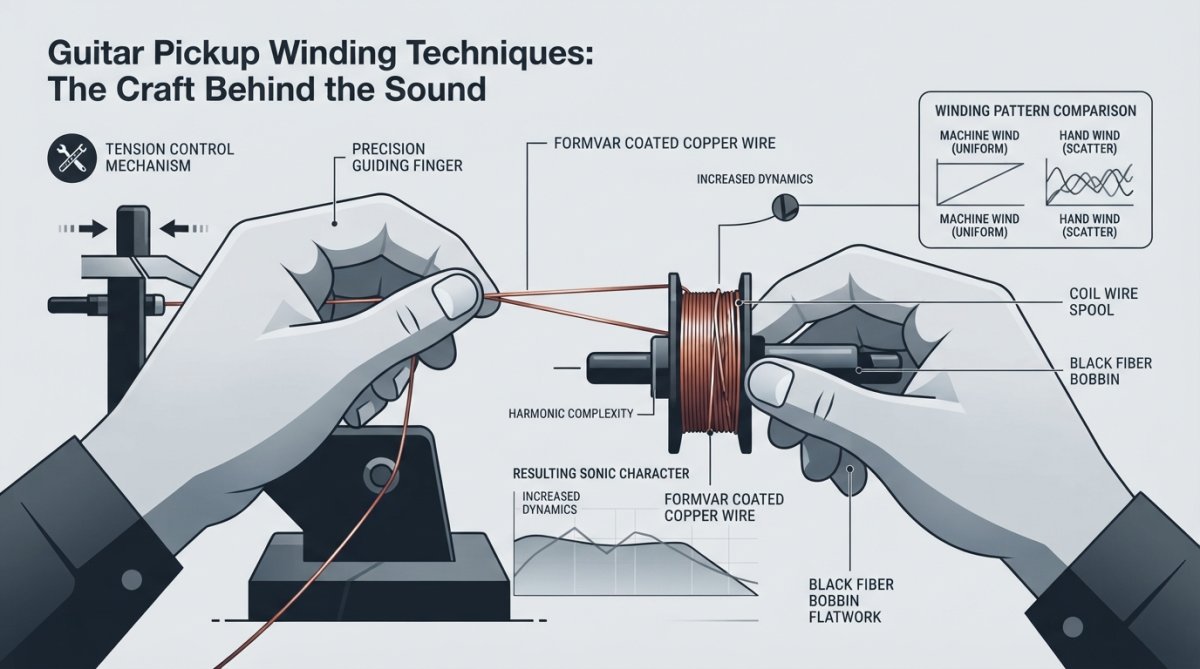
Wire tension typically ranges from 200-600 grams of force, depending on wire gauge and desired coil density. Too little tension results in loose, inconsistent wraps; too much can deform wire or crack the bobbin. Experienced winders develop feel for correct tension.
Winding speed also matters. Fast winding (3,000-5,000 RPM) produces tighter, more uniform wraps with less control over scatter patterns. Slow winding (500-1,500 RPM) allows deliberate control. Most hand-wound pickups wind at 1,000-2,000 RPM, balancing control and efficiency.
The winding pattern is where craft becomes critical. Some winders create deliberate scatter by varying bobbin rotation speed or wire feed angle. The goal is enough variation to break up uniform resonance peaks without introducing inconsistent output.
Wire Gauge, Insulation, and Dynamic Range
Wire gauge is one of the most significant variables. Thinner wire (0.040-0.042") allows more turns, increasing inductance and output. Thicker wire (0.048-0.052") reduces turn count but lowers DC resistance and extends high-end response.
Wire insulation thickness also affects performance. Standard polyurethane insulation is 0.001-0.002" thick. Thicker insulation improves durability but reduces copper fill factor. Thinner insulation maximizes copper content and inductance.
Dynamic range, the pickup's ability to respond to variations in pick attack, is influenced by wire gauge and coil inductance. Lower inductance pickups have wider dynamic range; higher inductance pickups compress dynamics slightly, sounding smoother but less responsive.
Hand-wound construction allows builders to select wire gauge based on desired dynamic response. Machine-wound pickups are limited to whatever the production line is configured for.
Touch Sensitivity and Microphonics Control
Touch sensitivity refers to how much output changes with variations in playing dynamics. It's determined primarily by coil inductance and output impedance. Lower inductance pickups have higher touch sensitivity; higher inductance pickups have lower touch sensitivity.
Microphonics, how much a pickup responds to mechanical vibration of the coil itself, is controlled through wax potting and winding tightness. Loose windings vibrate more freely, increasing microphonics. Many vintage pickups have moderate to high microphonics, contributing to their responsive character.
Modern hand-wound pickups often use wax potting to reduce microphonics while preserving scatter-wound tonal characteristics. The wax fills gaps between wire wraps, damping vibration without significantly changing electrical properties.
Vintage Guitar Tone: PAF Legacy and Modern Hand-Wound Design
The PAF (Patent Applied For) pickup, introduced by Gibson in 1957, established the template for modern hand-wound design. PAF pickups used scatter-wound construction, alnico V magnets, and relatively low turn counts (around 5,000 turns), delivering warm, responsive tone with complex harmonic content.
1950s and 1960s PAF Pickups: The Standard
Early PAF pickups were hand-wound because machine-winding technology was unreliable. The scatter-wound pattern wasn't deliberate, it resulted from hand-winding with basic equipment, yet created tone that defined classic rock and blues.
Original PAF pickups measured:
- DC resistance: 7.2-7.8 kΩ
- Output impedance: 8-12 kΩ
- Capacitance: 90-110 pF
- Resonance peak: 4.5-5.5 kHz
- Inductance: 3.5-4.2 H
These specifications produced warm, compressed tone with moderate output and exceptional touch sensitivity.
Achieving Vintage Specs with Modern Precision
Modern hand-wound pickups achieve PAF-equivalent tone by engineering scatter-wound construction to match these specifications deliberately. Contemporary winders use tension control, bobbin guides, and wire-feed systems to recreate the scatter pattern with precision.
The Haynes Golden Root 1957 Stratocaster pickup set (£89.00) uses hand-wound scatter construction with period-correct wire gauge and alnico magnets to deliver the warm, responsive character of 1950s Fender Stratocasters. The Haynes Golden Root 1963 Stratocaster pickup set (£89.00) targets the brighter, more articulate tone of early 1960s designs.
The Mojo Factor: Separating Tone Reality from Marketing Myth
The term "mojo" refers to indefinable tonal magic, the sense that vintage pickups sound better than modern ones. This narrative is partly marketing, partly legitimate physics, and partly psychological.
Vintage pickups do sound different because of component aging, alnico magnet degradation, and scatter-wound patterns from 1950s equipment. These differences are measurable, DC resistance increases as wire corrodes, magnet strength decreases over decades.
However, much "mojo" mystique is overstated. A well-engineered modern hand-wound pickup can match or exceed vintage tonal characteristics without the fragility of aged components. Blind listening tests produce more ambiguous results than subjective comparisons.
What Science Reveals About Hand-Wound Sound
Research from the Journal of the Audio Engineering Society on pickup design confirms hand-wound scatter-wound pickups produce measurably different frequency response than machine-wound uniform pickups. The differences are real and audible.
Hand-wound pickups excel at delivering broad resonance peaks (warm tone), preserving harmonic complexity, and responding dynamically to playing variations. Machine-wound pickups excel at delivering focused resonance peaks (bright tone), maintaining linear frequency response, and providing consistency.
The "best" approach depends on application. Vintage tone seekers should choose hand-wound scatter-wound construction. Modern clarity seekers should choose machine-wound uniform construction. Tone quality depends far more on overall design than winding method alone.
Maintenance, Longevity, and Wax Potting
Hand-wound pickups with proper wax potting are extremely durable and can last decades without performance degradation. However, they're more vulnerable to environmental stress than machine-wound alternatives if not properly sealed.
Wax potting is standard protection, involving heating wax to 140-160°C, submerging the wound coil, and allowing it to cool. The wax fills gaps and seals the coil surface. Most modern hand-wound pickups are wax-potted before installation.
Maintenance is straightforward: keep them dry, avoid extreme temperature changes, and protect from corrosive environments. A wax-potted hand-wound pickup will outlast the guitar it's installed in.
Is the Investment in Hand-Wound Pickups Worth It?
Hand-wound pickups typically cost £80-150 per set, a meaningful investment comparable to a quality guitar cable or effects pedal. The return on investment depends on your playing style.
Blues and classic rock players see the most value, these styles benefit from warm, responsive tone and touch sensitivity that hand-wound scatter-wound construction delivers. Jazz and clean tone players also benefit from harmonic complexity and dynamic response. High-gain and metal players see less dramatic improvement since heavy distortion masks tonal differences. Session musicians should prioritize consistency over character.
Haynes Hand-Wound Pickup Options for Your Build
The Haynes Golden Root P90 Classic (£115.00) delivers the raw, vocal character of original P90 designs with bright, punchy tone and significant dynamic range.
The Haynes Golden Root 62 Jazz Bass Pickups (£105.00) target the warm, expressive tone of 1960s jazz bass designs with period-correct specifications.
For Stratocaster players, the Haynes Golden Root 1957 Stratocaster pickup set emphasizes warmth and compression, while the Haynes Golden Root 1963 Stratocaster pickup set (both £89.00 per set) emphasizes articulation and presence.
Each Haynes pickup set winds individually to specification, ensuring scatter-wound patterns deliver intended tonal character while maintaining consistency across the set.
Conclusion: Making the Hand-Wound Choice
Choosing hand-wound pickups is a decision about tone philosophy. Hand-wound scatter-wound construction delivers warm, responsive, harmonically complex tone that many players prefer for blues, rock, and jazz applications.
The decision isn't about hand-wound being objectively superior, both approaches deliver excellent results when properly engineered. It's about matching construction method to your specific needs: vintage tone character, touch sensitivity, or harmonic complexity.
If you're building a guitar focused on classic tone, hand-wound pickups from Haynes Guitar & Bass Build offer the scatter-wound construction and vintage specifications that deliver the warmth and responsiveness these instruments demand. Each pickup winds to specification with attention to tension control, wire gauge, and coil geometry, ensuring intentional variation that creates character without sacrificing consistency.
The difference between a guitar that sounds good and one that sounds exceptional often comes down to the pickups. If your current setup lacks the warmth, responsiveness, or harmonic complexity you're chasing, hand-wound pickups from Haynes Guitar & Bass Build deliver the scatter-wound construction and vintage-inspired design that transforms how your instrument sounds. Start with the pickup set matching your tonal goals and experience the difference that thoughtful hand-wound construction makes.
Frequently Asked Questions
What is the difference between hand-wound and machine-wound pickups?
Hand-wound pickups are wound manually by a skilled craftsperson who controls tension, winding pattern, and coil geometry throughout the process. Machine-wound pickups use automated equipment that maintains consistent speed and tension but cannot adapt to subtle variations. Hand-wound construction allows for scatter winding patterns and precise touch sensitivity adjustments that machine-wound methods struggle to replicate, resulting in more organic tone profiles and improved dynamic range.
Do hand-wound pickups really sound better than machine-wound alternatives?
The tonal difference depends on winding technique and materials. Hand-wound pickups can achieve more harmonic content and reduced microphonics through careful tension control and selective scatter winding. However, modern machine-wound pickups from quality manufacturers are competent. The advantage lies in customisation, hand-wound construction allows builders to target specific vintage specs, capacitance values, and resonance peaks. Whether this translates to 'better' sound depends on your tone preference and playing style.
Are hand-wound pickups worth the extra cost?
Hand-wound pickups typically cost £80-£115 per set compared to £40-£60 for mass-produced alternatives. The investment is worthwhile if you prioritise tone customisation, vintage authenticity, or building a bespoke instrument. For gigging musicians or those upgrading existing guitars, hand-wound pickups can deliver noticeable improvements in touch sensitivity and harmonic character. For casual players, the difference may be subtle. Consider your budget, your instrument's overall quality, and whether tone refinement justifies the premium.
How do scatter-wound pickups differ from uniform winding patterns?
Scatter-wound pickups vary the winding pattern across the bobbin, which reduces capacitance peaks and smooths the high-end frequency response. This technique minimises sterile-sounding resonance peaks common in uniform machine-wound coils. Hand-wound scatter winding requires skill and intentional variation in tension and pattern placement. The result is a more organic, less brittle tone with better touch sensitivity. This is a hallmark technique of vintage PAF pickups and remains a key advantage of hand-wound construction.
This article was written using GrandRanker