

High Quality Guitar Component Parts: A Buyer's Guide
Table of Contents
- What Makes High Quality Guitar Component Parts Worth the Investment
- Pickups and Electronics: The Heart of Your Sound
- Hardware Components: Bridges, Machine Heads, and Tremolo Systems
- Wiring, Potentiometers, and Control Electronics
- Body and Neck Components: Tonewood, Nuts, and Saddles
- Component Compatibility Matrix: Ensuring Parts Work Together
- Tone Impact Analysis: What Actually Changes Your Sound
- DIY Upgrade Difficulty Ratings: What You Can Handle
High Quality Guitar Component Parts: A Buyer's Guide
Last Updated: August 3, 2026
When building or upgrading a guitar, component quality determines whether you get a playable instrument or an exceptional one. High quality guitar component parts unlock tonal characteristics, improve playability, and create an instrument that responds to your playing style. At Haynes Guitar & Bass Build, we've spent years sourcing premium components that transform custom builds and existing instruments. This guide walks you through essential components, how they interact, and which upgrades deliver the most noticeable improvements.
A cheap bridge won't hold intonation. Poorly wound pickups introduce noise and limit frequency response. Undersized potentiometers crackle and fade. Conversely, precision-engineered parts, a hand-wound pickup set or a fixed bridge with proper mass, transform how your guitar feels and sounds.
What Makes High Quality Guitar Component Parts Worth the Investment
The three pillars of component quality are tone, durability, and playability. Mass-produced parts often sacrifice one or more to hit a price point. A cheap potentiometer feels smooth initially, then develops scratching and crackling. Budget pickups sound thin and lack definition. Hardware made from soft alloys strips threads or bends under string tension.
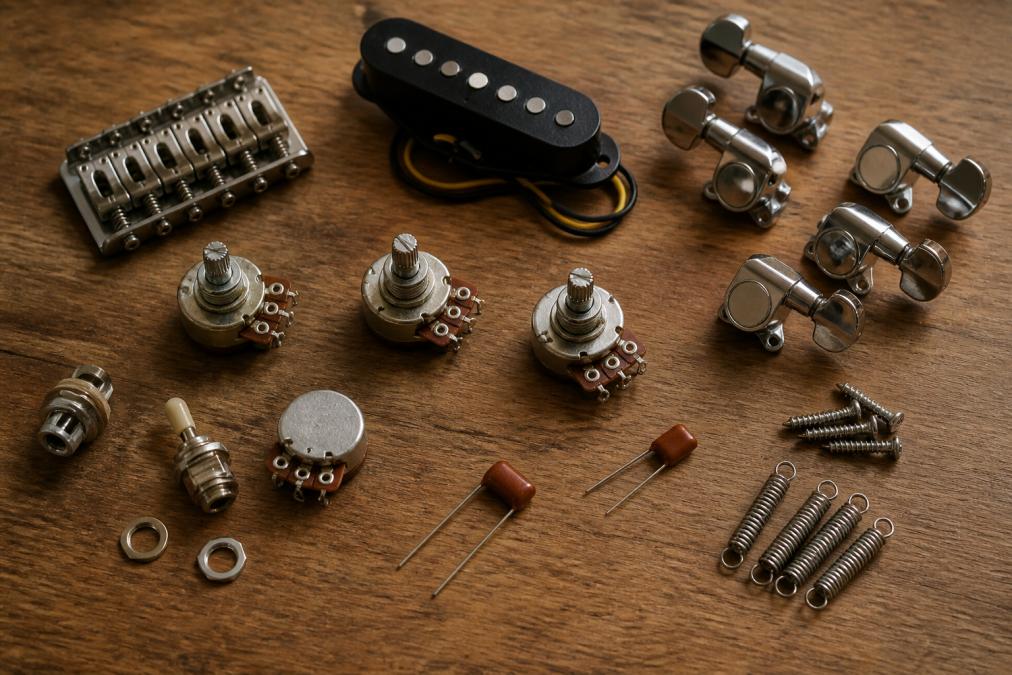
Tone, Durability, and Playability: The Three Pillars
Tone isn't determined by pickups alone. A cheap nut creates dead spots on the fretboard. A poorly designed bridge dampens sustain. Substandard wiring introduces capacitance that colours your signal. Multiple quality upgrades create a cumulative effect far greater than any single component.
Durability determines how long your investment pays dividends. A hand-wound pickup maintains consistent output and frequency response for decades. Factory-made pickups with cheaper magnet materials degrade over time, losing clarity and output. Hardware made from quality materials resists corrosion and maintains tight tolerances through years of string tension and temperature changes.
Playability encompasses action, intonation, and feel. The nut affects action at the headstock. Bridge saddles determine action at the body end and influence how strings couple energy into the instrument. Machine heads with tight tolerances hold tuning stability. Potentiometers with smooth tapers give fine control over tone without dead zones.
Why Mass-Produced Parts Fall Short
Mass production optimises for cost, not performance. Factory winding machines produce hundreds of pickups daily but can't match hand-wound consistency. Machine-wound coils often have uneven tension, affecting frequency response and introducing microphonic noise. Budget magnet materials have looser quality control, leading to batch-to-batch variation.
Stamped hardware and soft alloy bodies save manufacturers pennies but create problems for players. Stamped bridges have less mass, reducing sustain. Soft alloy bodies strip threads when tightening bridge saddle screws. Cheap potentiometers use carbon film resistive elements that wear quickly. The cost difference between budget and quality components is often surprisingly small, 10-15% higher for pickups, 20-30% for hardware, but the performance gap is substantial.
Pickups and Electronics: The Heart of Your Sound
Pickups convert string vibrations into electrical signals. Everything downstream, your amp, effects chain, mixing console, amplifies and processes what the pickup captures. Pickup quality matters more than almost any other component.
Hand-Wound vs Factory-Made Pickups
Hand-wound pickups are wound by a person controlling tension, speed, and wire path to achieve specific tonal characteristics. Factory pickups are wound by automated machines programmed to achieve a target number of turns at a target speed.
Hand-wound pickups from experienced builders exhibit tonal personality. Each pickup is wound to specification, but the builder adjusts winding tension and wire path to achieve specific frequency response and feel. Factory pickups prioritise consistency, producing pickups that measure identically but often sound generic.
The Bare Knuckle Pickups hand-wound construction process demonstrates how hand-wound pickups differ from factory alternatives. Their builders adjust winding tension and magnet stagger based on the specific guitar model and intended use.
Understanding Impedance and Output Ratings
Pickup impedance (measured in ohms) and output (measured in millivolts) define how a pickup behaves in your circuit. A typical Strat neck pickup measures around 5.5-6.5 kilohms (kΩ) impedance and 150-180 millivolts (mV) output. A bridge pickup runs 7-8.5 kΩ and 200-240 mV. These values balance output with frequency response. Higher impedance pickups have more output but narrower frequency response. Lower impedance pickups have less output but broader, more articulate frequency response.
Match impedance to your potentiometer values. A 500k potentiometer pairs well with 7-8k impedance pickups. A 250k potentiometer works better with 5-6k impedance pickups. Mismatching creates tonal problems: too-high impedance into too-low pot resistance rolls off high frequencies excessively. Output rating tells you how much signal the pickup generates. Higher output pickups (250+ mV) suit high-gain styles. Lower output pickups (150-180 mV) suit clean tones and vintage-style amplifiers.
Hardware Components: Bridges, Machine Heads, and Tremolo Systems
Hardware is where high quality guitar component parts make tangible differences in playability and tuning stability. A quality bridge holds intonation. A quality machine head holds tuning. A quality tremolo system stays in tune when you use it.
Fixed Bridges vs Tremolo: Impact on Sustain and Intonation
Fixed bridges couple string vibration directly into the body wood, maximising energy transfer and sustain. Tremolo bridges sacrifice some sustain for the ability to bend pitch with the whammy bar.
For pure sustain and intonation stability, a fixed bridge is superior. The Gotoh 510 fixed bridge specifications exemplifies high quality guitar component parts. The bridge plate is machined from solid steel, saddles are precisely cut, and the mounting system maintains tuning stability under string tension and temperature changes.
Tremolo systems introduce complexity. A quality tremolo system uses precision-machined pivots, quality springs, and well-designed saddles to minimise tuning drift. Budget tremolo systems use soft alloy bodies that flex under string tension and loose pivots that develop play. If tuning stability is your priority, choose a fixed bridge. If you want tremolo functionality, budget for a quality system.
Machine Heads and Tuning Stability
Machine heads are where string tension meets the headstock. A quality machine head has tight tolerances, smooth gearing, and a worm gear design that holds tuning without slipping. Budget machine heads use loose tolerances and soft alloy bodies that strip threads.
The gear ratio (typically 14:1 to 18:1) determines how many turns of the tuning peg equal one full rotation of the shaft. For most players, 16:1 or 17:1 is the sweet spot. Locking machine heads hold the string in place without wrapping, reducing the number of wraps needed and improving tuning stability. Quality machine heads cost 50-100% more than budget alternatives but hold tuning better on expensive bodies.
Wiring, Potentiometers, and Control Electronics
The electronics cavity is where many budget guitars fail. Cheap potentiometers crackle and fade. Undersized capacitors introduce noise. Poor shielding allows electromagnetic interference to couple into your signal.
Potentiometers: 250K vs 500K and Why It Matters
Potentiometers control volume and tone. The resistance value (250k or 500k ohms) affects the frequency response of the tone control. A 250k pot paired with a 0.047µF capacitor creates a low-pass filter that rolls off high frequencies more aggressively than a 500k pot with the same capacitor value. This is why Strats sound warmer than Teles.
Higher pot value equals brighter tone control. Lower pot value equals warmer tone control. Match pot values to your intended tone. Strat pickups (typically 5.5-6.5 kΩ impedance) pair well with 250k pots. Tele pickups (typically 7-8 kΩ impedance) work better with 500k pots.
[CTS potentiometers for guitar electronics(https://avhkbx-bp.myshopify.com/blogs/news/how-to-upgrade-guitar-electronics) | hotroxuk.com] are widely considered the gold standard. CTS pots use quality carbon film resistive elements, tight tolerances, and smooth tapers that eliminate dead zones. A budget pot might feel smooth initially but develops scratchy channels within a year. A CTS pot operates smoothly for decades. The cost difference is minimal, £6-10 for a quality pot versus £2-3 for a budget pot, but the difference in feel and longevity is dramatic.
Capacitors, Resistors, and Tone Shaping
Capacitors are the other half of the tone control circuit. A capacitor's value (measured in microfarads, µF) determines the frequency at which the tone control begins to roll off highs. A 0.047µF capacitor creates a gentler roll-off than a 0.022µF capacitor.
Budget guitars often use cheap film capacitors with loose tolerances (±20%) and poor frequency stability. Quality capacitors (like Sprague Orange Drops or Vishay MKS) have tight tolerances (±5%) and stable frequency response. Metal film resistors (1% tolerance) are the standard for guitar applications, offering tight tolerances and low noise floors compared to budget resistors.
Wiring Harnesses and Shielding
Wiring harness quality affects signal integrity and noise rejection. Budget harnesses use thin, unshielded wire that picks up electromagnetic interference. Quality harnesses use proper gauge wire, shielded cables where appropriate, and star-grounding techniques that minimise noise.
Shielding is critical in the electronics cavity. Cavity walls should be shielded to reject electromagnetic interference. The shield must be grounded to the same point as the output jack. ObsidianWire solder-less wiring harnesses represent a modern approach to high quality guitar component parts. Their harnesses are pre-assembled with quality components, shielded, and designed for easy installation without soldering.
Body and Neck Components: Tonewood, Nuts, and Saddles
The body and neck are your instrument's foundation. Their wood selection, construction quality, and hardware all influence tone and playability.
Tonewood Selection and Resonance
Tonewood selection affects sustain, resonance, and tonal character. Alder is warm and balanced. Ash is bright and articulate. Mahogany is warm and woody. Maple is bright and snappy. Density and grain structure matter more than species. A dense, tight-grained piece of alder sounds brighter and more articulate than a soft, open-grained piece.
Nuts and Saddles: Material and Impact on Action
The nut determines action at the headstock and influences how strings couple energy into the neck. Cheap nuts develop grooves where strings rest, causing tuning instability and dead spots. Quality nuts resist groove formation and provide consistent string coupling.
Graph Tech TUSQ XL nuts for guitar tone and tuning stability exemplify high quality guitar component parts. TUSQ XL resists string wear, self-lubricates to reduce binding, and provides excellent acoustic coupling. Bridge saddles have the same relationship with bridge design. Cheap saddles wear quickly. Quality saddles resist wear and couple more energy into the body, increasing sustain and brightness.
Component Compatibility Matrix: Ensuring Parts Work Together
Components must work together as a system. A great pickup won't perform well if wired to a cheap potentiometer. A quality bridge won't improve sustain if the body is made from soft wood.
| Component | Consideration | Impact |
|---|---|---|
| Pickup impedance | Match to potentiometer value (250k or 500k) | Tone control response and frequency range |
| Bridge mass | Heavier bridges increase sustain | Lighter bridges reduce sustain but improve clarity |
| Nut material | Hard materials resist wear and maintain action | Soft materials develop grooves and tuning drift |
| Wiring gauge | Thicker wire reduces resistance and noise | Thinner wire introduces noise and signal loss |
| Capacitor value | Lower values create gentler tone roll-off | Higher values create aggressive tone roll-off |
Scale Length and Hardware Fit
Scale length (the distance from the nut to the bridge) determines which hardware will fit your guitar. A Strat typically has a 648mm (25.5-inch) scale, while a Les Paul often features a 628mm (24.75-inch) scale. Hardware designed for one scale length won't fit another.
Machine heads are the most obvious example. Bridge saddle spacing and bridge plate dimensions also vary by scale length. Verify that the scale length matches your body and neck. Nut width varies by instrument type. A Strat nut is typically around 42.8mm wide at the base, a Tele nut is slightly wider, and a Les Paul nut is wider still. Always verify nut width before ordering.
Pickup mounting varies by instrument type. Strats use routed cavities with specific dimensions. Teles use simpler routing. Les Pauls use different cavity shapes. Some aftermarket pickups come with mounting rings or brackets that adapt to different cavity shapes. Humbucker pickups come in two sizes: standard (roughly 35mm x 70mm) and mini. Verify the cavity dimensions before ordering pickups.
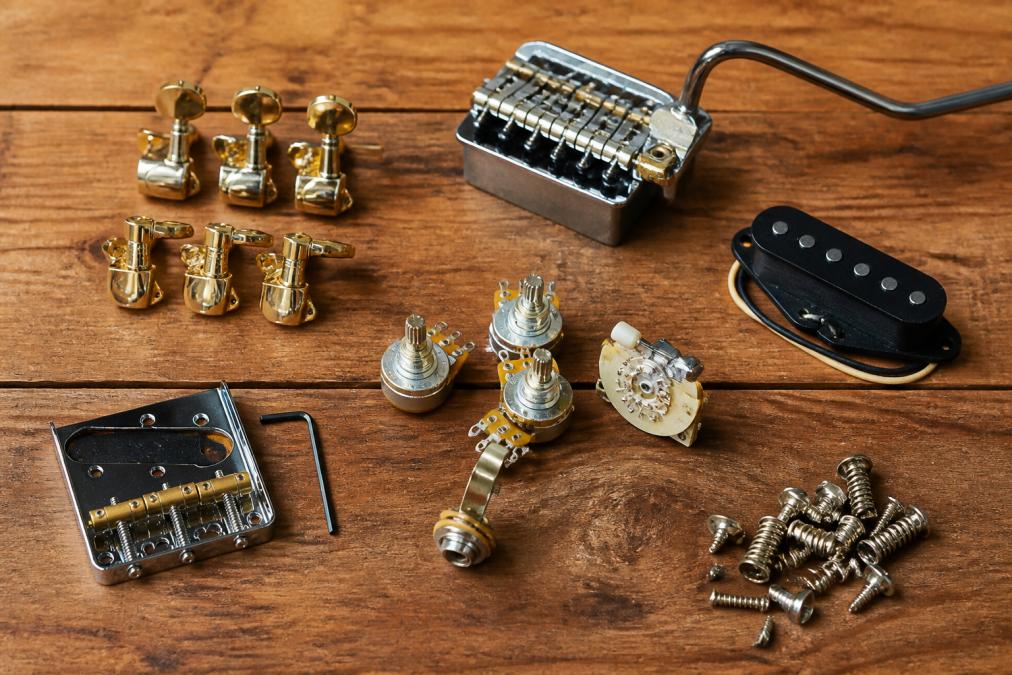
Tone Impact Analysis: What Actually Changes Your Sound
Not all components have equal impact on tone. Some changes are subtle and only noticeable in quiet settings. Others are dramatic and obvious immediately.
Pickup Coil Winding and Frequency Response
Pickup coil winding directly determines frequency response. A tightly wound coil has higher impedance and more output but narrower frequency response. A loosely wound coil has lower impedance and less output but broader frequency response. Hand-wound pickups sound different from factory pickups because the winder adjusts tension and turn count to achieve specific frequency response.
The most noticeable tonal difference between budget and quality pickups comes from coil winding consistency and magnet material. Budget pickups often have uneven winding tension, creating frequency response irregularities and introducing microphonic noise. Quality pickups have even winding tension and consistent magnet material, resulting in smooth frequency response and low noise.
A hand-wound pickup set from Haynes Guitar & Bass Build, like the Haynes Golden Root 1957 Stratocaster pickup set at £89.00, delivers tonal character that factory pickups can't match. The winding is adjusted for vintage-correct frequency response, magnets are carefully selected for consistent output, and the overall tone is warm, articulate, and responsive to playing dynamics.
Bridge Mass and Sustain
Bridge mass directly affects sustain. A heavier bridge couples more string vibration into the body, increasing sustain and reducing high-frequency damping. A lighter bridge reduces sustain but increases clarity and definition. The difference between a cheap bridge and a quality bridge is often mass. A cheap stamped steel bridge weighs less than a precision-machined bridge made from denser material. This mass difference translates directly into sustain, a quality bridge increases sustain by 10-20% compared to a budget alternative on the same guitar.
The Gotoh 510 fixed bridge for enhanced sustain is heavier and more precisely machined than budget alternatives, resulting in noticeably longer sustain and improved intonation stability.
Electronics Configuration and Output Levels
The way you wire your electronics affects output level and tone control response. A well-designed wiring harness with proper component values delivers consistent output and smooth tone control. Output level is influenced by pickup impedance, potentiometer value, and capacitor value. Higher impedance pickups paired with higher potentiometer values deliver more output. Lower impedance pickups paired with lower potentiometer values deliver less output.
DIY Upgrade Difficulty Ratings: What You Can Handle
Not all upgrades require luthier skills. Some are straightforward swaps that any guitarist can handle in an afternoon. Others require specialized tools and experience.
Easy Swaps: Pickups, Potentiometers, and Jack Sockets
Pickup replacement is straightforward if your guitar has standard routing and wiring. Unsolder the old pickup leads, solder the new pickup leads to the same points, and you're done. This takes 30-60 minutes for someone comfortable with a soldering iron. A solder-less wiring harness eliminates the soldering step entirely. Potentiometer and jack socket replacement are similarly straightforward, usually just four solder joints.
Intermediate Work: Bridge Replacement and Wiring Harness Installation
Bridge replacement requires removing the old bridge, filling old screw holes with wooden dowels, drilling new holes, and installing the new bridge. This takes 1-2 hours and requires a drill, drill bits, and basic woodworking skills. Wiring harness installation requires removing the old harness, installing the new harness, and testing everything. This takes 2-3 hours and requires comfort with soldering or a solder-less harness.
Advanced Projects: Routing, Fretwork, and Neck Fitting
Routing requires a router, bits, templates, and experience. A mistake is permanent and expensive. Unless you have experience, have a professional handle this. Fretwork requires specialized tools and years of experience. Neck fitting requires woodworking skills and specialized tools. For most DIY builders, the sweet spot is easy swaps (pickups, pots, electronics) combined with professionally routed bodies and professionally fitted necks.
Building or upgrading a guitar with high quality guitar component parts is one of the most rewarding projects you can undertake as a musician. The challenge is navigating the choices, understanding which components matter most, how they work together, and which upgrades deliver the best results for your budget and playing style. Haynes Guitar & Bass Build specializes in exactly this kind of guidance. Whether you're sourcing hand-wound pickups like the Haynes Golden Root 1963 Stratocaster pickup set at £89.00, custom bodies, or precision-engineered necks, our team understands how to match components for optimal tone and playability. Start with your tone priority, are you chasing vintage warmth, modern clarity, or something in between?, then build your component list around that goal. The result will be an instrument that sounds and plays exactly how you want it to.
Frequently Asked Questions
What are the most important high quality guitar component parts to upgrade first?
Pickups deliver the most noticeable tone change, followed by the bridge for sustain and intonation. If your current electronics feel scratchy or unresponsive, upgrade potentiometers and capacitors next. The nut affects tuning stability and sustain. Most builders prioritize pickups first because they're easiest to swap and have the biggest sonic impact. Hand-wound pickups like the Haynes Golden Root sets (£89-£140) offer measurable improvements over factory pickups in clarity, harmonic content, and responsiveness.
How do I know if guitar component parts are actually high quality?
Look for hand-wound pickups (not machine-wound), precision-machined hardware with tight tolerances, and components made from quality materials like nickel-silver saddles or bone nuts. Check if the maker publishes specifications: coil resistance, impedance ratings, and magnet type. UK makers like Haynes Guitar & Bass Build and Bare Knuckle Pickups publish these details because quality is verifiable. Avoid vague marketing language; real quality comes with measurable specs, warranties, and builder communication about your specific tone goals.
Can I upgrade guitar electronics myself, or do I need a luthier?
Many upgrades are DIY-friendly. Pickup swaps, potentiometer replacements, and capacitor upgrades require only basic soldering skills and take 1-2 hours. Bridge replacement is straightforward on most guitars. However, nut replacement, fretwork, and neck fitting require luthier tools and experience. If you're building your first partscaster, start with pickups and electronics. Solder-less wiring harnesses eliminate soldering entirely, making electronics upgrades accessible to complete beginners. Save routing and fretwork for experienced builders or professionals.
What's the actual cost difference between upgrading parts versus buying a new instrument?
A quality partscaster build costs £400-£800 depending on body, neck, and component choices. Upgrading an existing £300 guitar with new pickups (£89-£140), hardware (£80-£150), and electronics (£40-£100) totals £210-£390 and often yields better results than a budget new guitar. However, building from scratch lets you choose every component for your exact tone and feel. Custom builds from makers like Haynes Guitar & Bass Build start around £1,200-£2,000 for complete instruments, justified by hand-wound pickups, custom bodies, and bespoke specifications.
How do potentiometers and capacitors actually affect guitar tone?
Potentiometers (volume and tone controls) determine how smoothly and responsively your tone changes. 250K pots suit single-coil pickups; 500K suit humbuckers. CTS potentiometers offer smoother operation than cheap alternatives. Capacitors shape the frequency response when you roll back tone controls. Paper-in-oil capacitors (like vintage specs) sound warmer; ceramic capacitors sound brighter. Upgrading from stock to quality components (CTS pots at £6.99, quality capacitors at £2-5 each) noticeably improves control feel and tone shaping precision without changing your pickup's fundamental character.
This article was written using GrandRanker