

Custom Guitar Body Shop UK: 8 Builders & Services
Table of Contents
- What to Expect from a Custom Guitar Body Shop UK
- Replacement Guitar Bodies: Materials and Routing Standards
- Bespoke Guitar Bodies UK: Custom Specifications
- UK Guitar Body Finishing Services: Nitro and Poly Options
- Electric Guitar Body UK Custom Builds: Full Assembly
- Luthier Services UK: Custom Necks and Professional Repairs
- Budget vs Professional Build: Cost Comparison
-
Top Custom Guitar Body Shops in the UK
- Haynes Guitar & Bass Build: Hand-Wound Pickups and Precision Craftsmanship
- RF Custom: CNC Precision and Diverse Finish Options
- Rigby Music: Full Refinishing and Setup Services
- Ancoats Guitars: Interactive Builder and Original Designs
- Waghorn Guitars: Handmade Acoustic and Electric Options
- Manchester Guitar Tech: Nitrocellulose Expertise
- T Dog Customs: Specialist Finishing and Relic Work
Custom Guitar Body Shop UK: 8 Builders & Services
Last Updated: August 2, 2026
When you're serious about tone, a custom guitar body shop uk isn't just a convenience, it's an investment in an instrument tailored to your exact specifications. At Haynes Guitar & Bass Build, we know that finding the right builder means understanding what separates a generic build from a precision instrument. The quality of the body, tonewood choice, and routing precision determine how your guitar sounds and feels.

The UK custom guitar market has evolved significantly. Builders now offer CNC precision alongside traditional hand-finishing, nitrocellulose lacquer finishes rivalling vintage guitars, and meticulous attention to detail once reserved for boutique shops.
What to Expect from a Custom Guitar Body Shop UK
Reputable builders operate on a made-to-order basis, building your guitar specifically for you. This takes time, but it's why the final instrument sounds and plays better than mass-produced alternatives.
Tonewood Selection and Quality Standards
Body wood directly affects sustain, resonance, and tone character. Swamp ash delivers bright, articulate tone with excellent sustain and is lightweight. Red alder offers warmer, darker character with good tonal balance. Mahogany provides deeper midrange and thicker attack, favoured by players seeking vintage-voiced instruments.
Quality matters at every stage. Reputable builders source properly kiln-dried wood for stability. Quarter-sawn timber provides superior stability and more consistent tonal characteristics than flat-sawn wood.
Build Timeline and Communication
A realistic timeline ranges from 8 to 16 weeks depending on complexity and workload. The difference between a good experience and a frustrating one comes down to communication. Builders who provide progress photos, explain each stage, and respond to questions create confidence. You should expect regular contact throughout the build process.
Replacement Guitar Bodies: Materials and Routing Standards
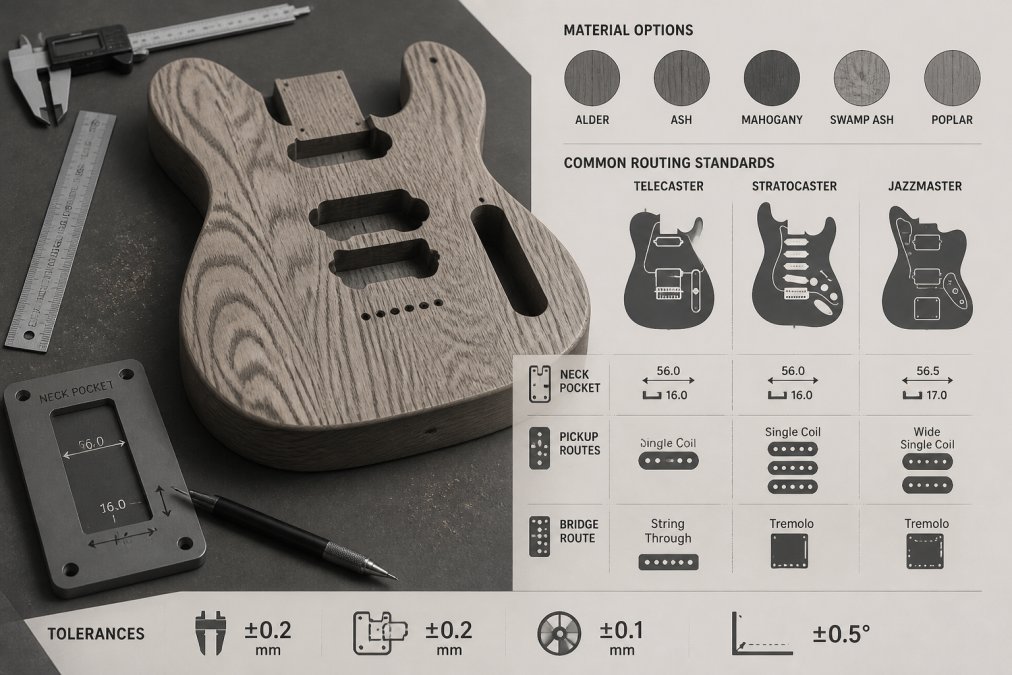
If you already have a neck and hardware, a replacement body can completely transform your instrument. The key is ensuring compatibility: neck pocket routing, bridge cavity depth, and hardware mounting holes must align perfectly with what you own.
Swamp Ash vs Red Alder: Tonewood Differences
Swamp ash is denser and more resonant, producing snappier attack and more defined note separation, particularly on clean tones. Red alder is lighter, producing warmer, rounder tone with more sustain through the midrange. For high-gain distortion or genres where midrange warmth matters, alder is often better. It's also more affordable and easier to finish consistently.
Visually, swamp ash has prominent grain patterns and naturally lighter colour. Red alder is more uniform, taking stain and finish more predictably.
Neck Pocket and Routing Compatibility
A custom guitar body shop uk must route the neck pocket to exact specifications. Bolt-on necks require specific pocket depth, width, and angle. If routing is even slightly off, the neck won't sit flush, causing playability issues or gaps.
Bridge cavity routing is equally important. The depth affects how your bridge sits. Pickup cavities must accommodate your specific pickups. A professional builder asks for exact hardware specifications and routes accordingly. Fender-style bolt-on routing has become standard, ensuring compatibility across many aftermarket necks and bodies. Offset designs like Jazzmasters and Jaguars require more specialized routing knowledge.
Bespoke Guitar Bodies UK: Custom Specifications
When you commission a bespoke body, you're defining every detail where personal preference, ergonomics, and sonic vision converge.
Body Contour and Playability
Body contour affects how the guitar sits against your body and upper fret access. A deeper lower bout provides more mass and sustain but can be uncomfortable sitting down. A shallower contour feels more comfortable but sacrifices some resonance. Belly cuts improve comfort without compromising tone.
Weight is a practical consideration. A heavier body (2.0 to 2.5 kilograms) sustains longer but causes shoulder fatigue. A lighter body (1.5 to 2.0 kilograms) plays comfortably all day but may lack sustain. The wood species you choose affects this directly.
Custom Offset and Double-Cut Designs
Offset designs like Jazzmasters and Jaguars require specialized routing knowledge. The offset body shape changes weight distribution and strap balance. Double-cut designs offer easier upper fret access and different aesthetics. The cutaway affects body mass and resonance differently than single-cut designs.
UK Guitar Body Finishing Services: Nitro and Poly Options
The finish you choose affects both aesthetics and tone.
Nitrocellulose Lacquer for Vintage Authenticity
Nitrocellulose finish is the gold standard for vintage-ounding guitars. It's thin, ages visibly, and allows wood to vibrate more freely than thicker finishes, contributing to better sustain and resonance. Nitro also feels better under your hands. The downside: it's labour-intensive, requires multiple thin coats, and is more susceptible to checking over time. Nitro finishes cost more and take longer, but the tonal and aesthetic benefits justify the investment if vintage character matters to you.
Step-by-Step Finishing: Sanding, Sealing, and Application
Professional finishing starts with meticulous sanding through progressive grits (120, 180, 220, 320, 400+). A thin sealer coat fills the wood grain and provides a foundation for the topcoat. For nitro, thin coats are applied and allowed to cure between applications. The final coat is sanded with very fine grit and buffed to the desired sheen.
Poly finishes are thicker and more durable, applied in fewer coats. Poly doesn't age visibly and provides better protection against dings and spills, but dampens vibration slightly, which some players feel reduces sustain.
Electric Guitar Body UK Custom Builds: Full Assembly
A complete custom build involves routing for pickups, installing hardware, and integrating electronics.
Pickup Cavity Routing and Hardware Installation
Pickup cavities must be routed to exact dimensions. Standard Fender single-coil cavities are well-documented, but humbucker cavities and custom specifications require precise measurement. The cavity depth affects how the pickup sits relative to the strings.
Hardware installation includes bridge mounting, tuner holes, and output jack routing. Bridge mounting is critical; the bridge must be positioned so intonation can be set properly across all strings.
Bridge Compatibility and Scale Length Considerations
Bridge compatibility affects intonation and sustain. Different bridge designs (hardtail, tremolo, wraparound) require different mounting approaches and affect vibration transfer.
Scale length affects playability and tone. A longer scale (e.g., Fender standard) feels different than a shorter scale (e.g., Gibson standard). Longer scales produce tighter string tension and slightly brighter tone; shorter scales feel easier to bend and produce warmer tone.
Luthier Services UK: Custom Necks and Professional Repairs
A complete custom build often includes a custom neck, where ergonomics, playability, and personal preference become tangible.
Bolt-On vs Set-Neck Construction
Bolt-on necks are removable and replaceable, easier to repair or upgrade. Set-neck construction glues the neck permanently into the body, creating a solid joint that some players feel improves sustain and resonance. Set-neck guitars are more difficult to repair if the neck breaks. The tonal difference is subtle but real; set-neck construction tends to produce slightly more sustain and a more cohesive tone.
Fretboard Radius and Custom Neck Profiles
Fretboard radius affects comfort. A more curved radius (e.g., vintage Fender) is comfortable for open chords but less ideal for bending. A flatter radius (e.g., modern Fender) is better for lead playing. A compound radius offers the best of both worlds.
Neck profile is deeply personal. A thick profile provides stability and feels substantial. A thin profile is easier to wrap your hand around and reduces fatigue. A modern C-shape is a middle ground. Custom profiles from a professional luthier are built to your hand size and playing style.

Budget vs Professional Build: Cost Comparison
The decision between building a partscaster yourself and commissioning a professional build comes down to budget, time, and desired outcome.
DIY Partscaster vs Masterbuilt Instruments
A partscaster costs £400 to £1,200 depending on parts quality. You source a body, neck, pickups, hardware, and electronics separately, then assemble them. The advantage: you control every component. The disadvantage: quality control is your responsibility. A poorly routed body won't accept a neck properly.
A masterbuilt instrument from a professional custom guitar body shop uk costs £2,000 to £4,000 for a complete build. At Haynes Guitar & Bass Build, our Custom Stratocaster Body - Built to Your Spec starts at £240, and full custom builds like the Haynes Demeanour Custom Guitar are priced at £3,200. Every component is chosen for compatibility, routing is precise, finishing is professional, and the builder stands behind the instrument.
Sustainability and Responsibly Sourced Tonewood
Environmental responsibility has become central to instrument building. Reputable builders source tonewood from sustainable suppliers and often use reclaimed or salvaged wood when possible. Swamp ash and red alder are generally more sustainable than tropical hardwoods. Some builders use reclaimed wood salvaged from buildings or furniture, offering unique grain patterns while avoiding new logging.
Top Custom Guitar Body Shops in the UK
| Builder | Speciality | Best For | Standout Feature |
|---|---|---|---|
| Haynes Guitar & Bass Build | Hand-wound pickups, bespoke builds | Tone-focused players | Superior resonance and sustain |
| RF Custom | CNC precision, diverse finishes | Modern designs, custom specs | Flip, chameleon, metal flake finishes |
| Rigby Music | Full refinishing, setup | Manchester-area customers | Complete overhaul services |
| Ancoats Guitars | Original designs, interactive builder | Custom aesthetic designs | Unique NQ and New Islington models |
| Waghorn Guitars | Handmade acoustic and electric | Discerning musicians | Premium tonewoods and hardware |
| Manchester Guitar Tech | Nitrocellulose expertise | Vintage-style builds | Authentic lacquer finishes |
| T Dog Customs | Specialist finishing, relic work | Vintage and custom finishes | Expert aging and patina |
Haynes Guitar & Bass Build: Hand-Wound Pickups and Precision Craftsmanship
Haynes Guitar & Bass Build stands apart because we understand that tone is the foundation of everything. Our hand-wound pickups are crafted to specifications that maximize clarity, sustain, and resonance. Unlike mass-produced pickups wound by machines, hand-wound pickups capture nuance that transforms how your guitar sounds.
Our custom bodies are routed with precision, finished in nitrocellulose lacquer for authentic vintage character, and assembled with attention to every detail. We offer full customization: choose your tonewood, body style, neck profile, and finish. Our Custom Offset Jazzmaster Body - Built to Your Spec and [Custom Telecaster Body - Built to Your Spec](https://haynesguitarandbassbuild.com/products/custom-telecaster-body) are built to your exact specifications at £240 each.

For players wanting a complete instrument, our Haynes SC22 Custom Guitar (£3,600) and Haynes Fidelity Guitar (£3,200) are fully customisable, made-to-order builds. Communication throughout the build process is standard; you'll see progress photos and have direct contact with the builder. Our Haynes Golden Root ST and Haynes Golden Root TT (both £1,800) offer exceptional value for hand-built instruments with hand-wound pickups included.
RF Custom: CNC Precision and Diverse Finish Options
RF Custom combines modern CNC technology with traditional finishing expertise. Their strength is precision; CNC routing eliminates human error and ensures consistency. Their finish options are exceptional, offering flip finishes, chameleon effects, and metal flake finishes that create visual depth and movement.
Rigby Music: Full Refinishing and Setup Services
Rigby Music in Stockport, Manchester, offers comprehensive refinishing services. If you have a guitar body needing a complete aesthetic overhaul, they can strip it down, refinish it, and set it up for playing. Starting from £250 for an unfinished Fender-style body, they can transform your instrument with nitro or poly finishes, bursts, sparkles, and relicing.
Ancoats Guitars: Interactive Builder and Original Designs
Ancoats Guitars stands out for original design work. Rather than copying classic designs, they've developed unique models like the NQ and New Islington that blend vintage inspiration with modern aesthetics. Their online guitar builder lets you customize extensively: body shape, woods, colours, pickups, and hardware.
Waghorn Guitars: Handmade Acoustic and Electric Options
Waghorn Guitars builds handmade acoustic and electric instruments with meticulous attention to detail. Every aspect is customisable, from neck construction using hand-laminated quarter-sawn timber to hardware selection. They source premium tonewoods globally and use high-quality pickups and hardware throughout.
Manchester Guitar Tech: Nitrocellulose Expertise
Manchester Guitar Tech specializes in nitrocellulose lacquer finishes and custom builds. Their expertise in authentic vintage finishes is exceptional, understanding how to apply lacquer in ways that capture the character of 1950s and 1960s guitars.
T Dog Customs: Specialist Finishing and Relic Work
T Dog Customs specializes in finishing and refinishing, with particular expertise in relic work, artificially aging a guitar to look vintage. Their portfolio demonstrates exceptional finishing skill.
Real Customer Questions Answered
How long does a typical custom build actually take?
Most builders quote 8 to 16 weeks for a complete custom build. Communication during the build, with progress photos and updates, makes the wait feel manageable.
I'm not a luthier. Will a custom guitar body shop uk work with someone who doesn't know what they're doing?
Absolutely. Professional builders expect to work with players who have ideas but lack technical knowledge. A good builder asks questions, explains options, and guides you toward decisions that serve your tone and playability goals.
What's the actual cost difference between ordering a full custom build versus buying a production guitar and upgrading the pickups?
A production guitar costs £800 to £2,000, with pickup upgrades adding £300 to £600. A professional custom build costs £2,000 to £4,000, but every component is chosen for compatibility and tone. The custom build will sound and play better because it's designed as a cohesive instrument.
If something goes wrong during the build, like a routing mistake, what happens?
Reputable builders take responsibility for their work. A routing mistake is the builder's problem, not yours. They'll either fix it or provide a replacement body at no additional cost. Before committing, ask about their warranty and how they handle mistakes.
Do you actually communicate during the build process?
Check reviews and ask for references. Builders who communicate regularly, sending progress photos and responding to questions, create confidence.
Key Takeaways
- A custom guitar body shop uk offers precision, quality control, and tonal customization that production guitars can't match
- Tonewood choice fundamentally affects tone; discuss your sonic preferences with your builder
- Routing precision and hardware compatibility are non-negotiable
- Nitrocellulose finishes cost more and take longer but deliver superior tone and authentic vintage character
- Communication during the build process is essential; builders who update you regularly are more reliable
- A professional custom build delivers superior playability, tone, and long-term value compared to partscasters or upgraded production guitars
- Ask builders about tonewood sourcing and whether they use responsibly harvested or reclaimed wood
When you're investing in a custom guitar, you're commissioning a tool designed specifically for how you play and what you want to hear. The difference between a generic guitar and a precision-crafted custom build becomes obvious the moment you pick it up. At Haynes Guitar & Bass Build, we specialise in hand-built guitars and hand-wound pickups designed for superior tone. Every instrument we build is made to your specification, with communication throughout the process and a commitment to craftsmanship that shows in every detail. If you want a guitar that sounds exceptional and plays exactly how you want it to, explore our custom builds and discover what precision craftsmanship actually delivers.
Frequently Asked Questions
How much does a custom guitar body cost in the UK?
Custom guitar body pricing in the UK varies widely. Haynes Guitar & Bass Build offers replacement bodies from £240, whilst full bespoke builds start at £1,800 for models like the Golden Root series and rise to £3,600 for masterbuilt instruments like the SC22. Factors affecting price include tonewood selection, finish type, routing complexity, and whether the body is part of a complete build or a standalone replacement. Professional luthier services typically charge project-based fees requiring direct consultation.
What's the difference between a bespoke guitar body and a replacement body?
A replacement body is a pre-shaped, finished component designed to fit standard neck pockets and hardware, ideal for partscasters and upgrades. A bespoke guitar body is custom-designed to your exact specifications, including body contour, wood selection, routing layout, and finish. Bespoke bodies offer complete tonal and ergonomic control but require longer lead times and higher investment. Replacement bodies like those from Haynes start at £240 and are ready to assemble, whilst bespoke builds begin at £1,800 and are made-to-order.
How long does it take to get a custom guitar body made in the UK?
Build timelines vary significantly. Replacement bodies can be ready within weeks, whilst full bespoke builds typically take 8-16 weeks or longer depending on the luthier's workload and specification complexity. Communication during the build is crucial, reputable shops like Haynes provide regular updates. Always confirm expected timescales upfront, as some builders prioritise quality over speed. Complex finishes like nitrocellulose lacquer or intricate routing add time but ensure superior results.
What materials are best for a custom guitar body, swamp ash or red alder?
Both are excellent tonewoods with different characteristics. Swamp ash offers bright, articulate tone with pronounced grain, ideal for single-coil pickups and vintage aesthetics. Red alder delivers warm, balanced resonance with tighter grain and is slightly lighter, suiting modern and traditional designs equally. Your choice depends on desired tone, finish preference, and aesthetic. Haynes Guitar & Bass Build offers both options on their custom bodies, allowing you to select based on your sonic priorities and visual preferences.
Do custom guitar body shops in the UK offer guarantees if something goes wrong?
Reputable UK builders stand behind their work, though specific warranty terms vary. Before commissioning, ask about guarantees covering routing errors, finish defects, and structural issues. Professional shops like Haynes provide transparent communication throughout assembly to catch problems early. Always request a written agreement detailing what's covered, fretwork, hardware fit, finish quality, and what constitutes acceptable tolerances. Established builders with strong portfolios are more likely to honour commitments and resolve issues fairly.
This article was written using GrandRanker
1 comment
Spot on about neck pocket compatibility and bridge alignment being crucial before jumping into a build. I’m currently planning an alder body Strat project, and pairing a custom body with reliable guitar locking tuners and a quality bridge makes a huge difference in tuning stability. Appreciate the detailed UK builder roundup.