

Humbucker vs Single Coil: A Player's Guide
Table of Contents
- Humbucker vs Single Coil: The Core Differences
- How to Reduce Single Coil Hum and Electromagnetic Interference
- Tonal Character: Warmth, Brightness, and Articulation
- Output Levels, Sustain, and Magnetic Field Strength
- What is a P90 Pickup and How Does It Compare?
- Single Coil vs Humbucker for Beginners: Which Should You Choose?
- Pickup Selection by Genre and Playing Style
- Active vs Passive Electronics and Pedal Interaction
Last Updated: August 5, 2026
Humbucker vs Single Coil: The Core Differences
A humbucker and a single coil pickup are fundamentally different in how they capture string vibrations, shaping everything from noise floor to sustain and tonal character. Understanding these differences is essential whether you're building your first partscaster or upgrading an existing instrument.
At Haynes Guitar & Bass Build, we've spent years hand-winding both pickup types. The choice isn't about which is "better", it's about which suits your playing, signal chain, and tone.
What is a single coil pickup?
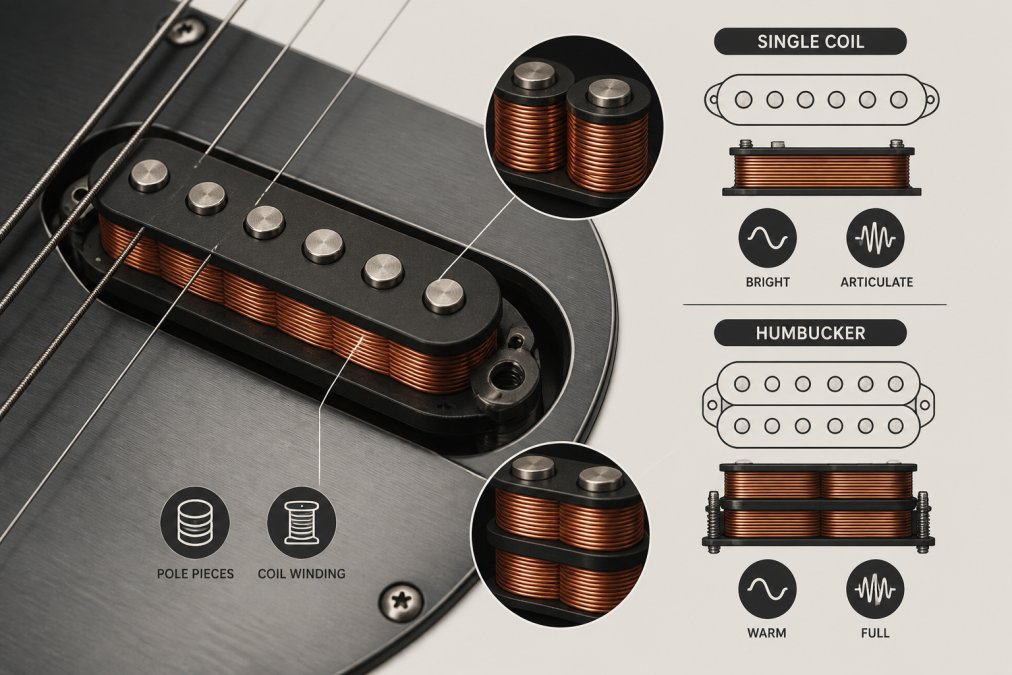
A single coil pickup consists of one coil of wire wound around a magnetic core with six pole pieces aligned with the strings. When strings vibrate, they disturb the magnetic field, and the coil detects this change as an electrical signal.
Single coils produce bright, articulate, clear tones with excellent note separation and dynamic response. The Fender Telecaster and Stratocaster made single coils legendary because they capture the nuance of your playing technique with remarkable sensitivity, every finger movement, string bend, and subtle variation in attack is audible.
The trade-off is noise. Single coil pickups are susceptible to 50/60-cycle hum from fluorescent lights, computer monitors, and high-gain amplifier settings. This hum comes from alternating current in your building's electrical system, whose magnetic field induces unwanted noise in the coil.
What is a humbucker pickup?
A humbucker pickup consists of two coils wound in opposite directions around the same magnetic core. The name tells the story: it "bucks" the hum by cancelling out electromagnetic interference through phase cancellation.
Because the coils are wound oppositely and wired in series, the desired signal adds up while 60-cycle hum cancels out. The result is a thicker, warmer, more sustained tone with a significantly quieter noise floor.
Humbuckers dominate rock, metal, and blues because they deliver the warmth and output those genres demand. A Gibson Les Paul Standard with Burstbucker humbuckers exemplifies this: thick, full, and sustaining. Two coils working together create more output impedance, delivering more signal to your amplifier and more natural overdrive.
The drawback is reduced articulation and brightness. The dual-coil design inherently reduces treble response and high-frequency clarity. You gain warmth and sustain; you trade some shimmer and snap.
How to Reduce Single Coil Hum and Electromagnetic Interference
Single coil hum is solvable through several approaches.
Shielding is the first line of defence. Copper foil or shielding paint applied to guitar cavities and electronics reduces electromagnetic interference by 50-70%. This requires opening your guitar, but if you're building a partscaster, this is the ideal time.
Pickup height adjustment matters. Lower the pickup 2-3mm from the strings to reduce both hum and output. This slightly warms the tone but eliminates noise for many players.
Coil splitting or series/parallel wiring lets you switch between humbucker and single-coil modes. Some humbuckers can be wired with a push-pull pot to use just one coil at a time, giving you single-coil brightness when needed and humbucker warmth otherwise. The Fender Player Stratocaster HSS uses a humbucker in the bridge position (where hum is worst) and single coils in the neck and middle (where they sound best).
Your amplifier and signal chain matter. A noise gate or noise suppressor pedal eliminates hum below a threshold. Many modern amplifiers have built-in noise reduction. Addressing hum at the source (shielding, pickup height) is better than gating it away.
Active electronics (onboard preamps) boost your signal before it travels down the cable, making it less susceptible to interference. This is why many metal players use active pickups.
Tonal Character: Warmth, Brightness, and Articulation
The tonal difference between single coils and humbuckers comes down to frequency response. Single coils emphasise treble and mid-range, delivering articulation and clarity. Humbuckers roll off high frequencies slightly, emphasising mid-range punch and warmth.
A Fender Player Telecaster with single-coil pickups delivers classic twang, almost percussive, with fast attack and excellent note definition. A Gibson Les Paul Standard '60s with Burstbucker humbuckers sits opposite: thick, warm, and full of sustain.
This difference shapes how the guitar responds to gain and distortion. Single coils pushed through distortion become aggressive and cutting; humbuckers become thick and compressed.
Pole pieces and magnet type matter. Alnico magnets (used in vintage-style pickups) produce warmer, more nuanced tones. Ceramic magnets produce hotter output and more aggressive tone. Single coils typically use Alnico 2 or 5; humbuckers often use ceramic or Alnico depending on whether the designer prioritises vintage warmth or modern output.
Single coils respond more dramatically to playing dynamics, pick harder for more treble and snap; play softer for rounder tone. Humbuckers compress dynamic range slightly, which is why they're preferred for high-gain playing where consistency matters.
Output Levels, Sustain, and Magnetic Field Strength
Humbuckers produce significantly higher output than single coils, changing how your guitar interacts with your amplifier and effects chain.
Higher output means more signal hitting your amp's input stage, causing preamp tubes or transistors to work harder and compress slightly. This natural compression and saturation is why humbuckers feel ideal for rock and metal. A Gibson Les Paul Standard will overdrive a tube amp at lower volumes than a Telecaster.
Single coils produce lower output, requiring more amplifier gain to achieve the same overdrive level. This gives you more control over when the amp breaks up, many blues and funk players prefer this.
Sustain results directly from magnetic field strength. Two coils create a stronger magnetic field than one, keeping vibrating strings in the field longer. A Les Paul with humbuckers sustains noticeably longer than a Strat with single coils. This is why sustain-hungry genres like metal favour humbuckers.
If you're using many pedals or high-gain amp settings, a humbucker's higher output and lower noise floor keep your signal chain cleaner. With a clean amp and minimal effects, a single coil's lower output and dynamic response may feel more natural.
What is a P90 Pickup and How Does It Compare?
A P90 pickup sits between a single coil and humbucker in design and tone. It's a single-coil design with a wider, flatter coil and larger pole pieces than a traditional single coil, producing higher output without dual-coil hum cancellation.
P90s deliver more output than Fender-style single coils and thicker tone, while retaining much articulation and brightness. The magnetic field is stronger than a typical single coil but less dominant than a humbucker.
The trade-off is noise. P90s are still single-coil designs susceptible to 60-cycle hum, though less so than traditional Fender single coils because of higher output. Many players find the hum acceptable for the characterful tone.
The Haynes Golden Root P90 classic captures this character: raw, vocal, and full of personality. P90s suit players wanting more output and warmth than a Strat but not the full warmth and sustain of a humbucker. They're popular in blues, garage rock, and punk.
Single Coil vs Humbucker for Beginners: Which Should You Choose?
The answer depends on what you want to play and your noise tolerance.
Choose single coils if you're drawn to bright, articulate tones and play in a relatively quiet environment. Single coils reward technique, responding to how you pick and fret, making them excellent for learning. The Fender Player Telecaster forces you to develop good technique; there's nowhere to hide. Single coils are also cheaper to replace if you want to experiment.
Choose humbuckers if you want thicker, warmer tones and play through higher-gain settings. If you're interested in rock or metal, a humbucker guitar like the Epiphone Les Paul Standard '60s delivers the tone you're chasing affordably. Humbuckers are more forgiving of sloppy technique because compressed dynamic range masks imperfections.
The hybrid approach is worth considering. The Fender Player Stratocaster HSS gives you both: a humbucker in the bridge position and single coils in the neck and middle. This lets you learn what each pickup type brings.
Pickup Selection by Genre and Playing Style
Different genres have strong pickup preferences for good reason.
Blues and funk favour single coils, particularly neck-position pickups, for articulation and dynamic response. A Telecaster neck pickup is the sound of blues tradition.

Rock and hard rock split between single coils and humbuckers. Classic rock (Led Zeppelin, AC/DC) is humbucker territory. Modern rock varies, some prefer single-coil aggression through cranked amps; others prefer humbucker natural compression.
Metal is almost exclusively humbucker territory. Output, sustain, and noise rejection make humbuckers essential for high-gain playing.
Country and Americana are single-coil strongholds. The twang and articulation are core to the genre. A Telecaster is the country guitar.
Indie and alternative rock use both, with a strong single-coil contingent for brightness and attitude.

Jazz traditionally uses humbuckers on hollow-body guitars, though modern jazz players use everything. The key is a pickup responding well to fingerstyle and producing warm, articulate tone.
Your playing style matters as much as genre. Heavy effects and distortion favour humbuckers' higher output and lower noise floor. Clean playing with minimal effects favours single coils' responsiveness and articulation.
Active vs Passive Electronics and Pedal Interaction
The electronics powering your pickups shape how your guitar responds to your signal chain.
Passive pickups (traditional design) produce a signal traveling directly to your amplifier with no battery or onboard preamp. Single coils and humbuckers are almost always passive. The signal is affected by cable capacitance, pedal input impedance, and amplifier input impedance. A long cable subtly warms tone through increased high-frequency rolloff.
Active pickups include an onboard preamp powered by a battery, boosting the signal before it leaves the guitar. This makes the signal less susceptible to cable and pedal interference. Active pickups typically have higher output, lower noise, and more consistent tone. Many metal and modern rock players use active pickups for this reason.
Pedal interaction differs significantly. Single coils interact more dramatically with effects because their lower output and higher impedance mean pedals affect their tone noticeably. A single-coil guitar through fuzz sounds different than a humbucker through the same pedal. Humbuckers' higher output and lower impedance mean they're less affected by pedal interaction, providing more consistency across your board.
Choosing between a humbucker and single coil isn't one-size-fits-all. It's about understanding what tone you're chasing, your playing environment, and how you want your guitar to respond to your hands and effects. At Haynes Guitar & Bass Build, we hand-wind both pickup types because the best pickup matches your vision. Whether building a partscaster from scratch or upgrading an existing instrument, our hand-wound pickups, like the Haynes Golden Root 1957 Stratocaster pickup set (£89.00) for classic single-coil brightness or the Haynes Golden Root P90 classic (£115.00) for something between the two worlds, deliver the tone you're after. Get started with a custom pickup set tailored to your specifications.
| Pickup Type | Output | Noise Floor | Sustain | Tonal Character | Best For |
|---|---|---|---|---|---|
| Single Coil | Low | Susceptible to hum | Moderate | Bright, articulate, responsive | Blues, funk, indie rock, clean tones |
| Humbucker | High | Quiet (hum-cancelling) | Long | Warm, thick, compressed | Rock, metal, high-gain, lead work |
| P90 | Moderate-High | Moderate hum | Moderate-Long | Warm with articulation | Garage rock, punk, vintage tones |
Frequently Asked Questions
Is a humbucker better than a single coil?
Neither is objectively better, it depends on your genre and tone preference. Humbuckers deliver thick, warm tones with excellent noise rejection, making them ideal for rock and metal. Single coils offer bright, articulate clarity perfect for blues and funk. A humbucker produces higher output and more sustain, while single coils respond dynamically to subtle playing variations. Many professionals use both: humbuckers for high-gain situations and single coils for clean, expressive playing.
How do I reduce single coil hum in my guitar?
Single-coil hum comes from 50-cycle electromagnetic interference. Practical solutions include: shield your guitar cavity with conductive tape to block external fields, position your amplifier away from fluorescent lights and electrical equipment, use a noise gate pedal to suppress hum during silent passages, or switch to a humbucker which cancels hum by design. Haynes hand-wound pickups are wound with precision shielding to minimise interference at the source.
What is a P90 pickup and how does it differ from humbuckers and single coils?
A P90 is a single-coil design with a larger coil and wider pole pieces than traditional single coils, offering a thick, vocal tone that sits between single-coil clarity and humbucker warmth. P90s produce higher output than standard single coils but with less hum-cancellation than humbuckers. They excel in rock, blues, and vintage-inspired tones. The Haynes Golden Root P90 captures this raw character with hand-wound construction, delivering the original rock and roll pickup sound.
Which pickup should a beginner choose?
Beginners benefit from humbuckers if they want forgiving, warm tones with built-in hum rejection, ideal for learning rock or metal. Single coils suit those exploring blues or funk, though they require quieter playing environments. Consider your intended genre first, then your tolerance for hum. Many players start with a versatile HSS configuration (humbucker bridge, single coils neck and middle) like the Fender Player Stratocaster, offering both options in one guitar.
How does pickup height adjustment affect tone?
Raising a pickup closer to the strings increases output and sustain but can introduce magnetic saturation, reducing clarity. Lowering it decreases output and sustain but improves articulation and reduces muddiness. Bridge pickups typically sit slightly lower than neck pickups to balance output. Experimentation is key: start with manufacturer recommendations, then adjust in small increments. A properly adjusted pickup maximises the magnetic field's interaction with the strings without sacrificing tonal definition.
This article was written using GrandRanker